Famous Christmas Paintings: 5 Famous Paintings of Christmas by Famous Artists
Before storybooks, artists carried the Christmas story. Here are five famous Christmas paintings, who made them, when, and what each one is really showing you.

Famous Christmas paintings include El Greco’s Adoration of the Shepherds, Leonardo da Vinci’s The Annunciation, Claude Monet’s Snow Scene at Argenteuil, Raphael’s Sistine Madonna, and Caravaggio’s Nativity with St Francis and St Lawrence. Some of these works tell scenes from the nativity story, and others simply capture the winter light and quiet feeling that people have come to associate with the season. All of them were made by some of the most remarkable artists in history.
There is a reason so many masters painted Christmas. For most of history, the story of the season was not told through storybooks. It was told through paintings, sculptures, and altarpieces. Only a small number of people could read, so church leaders relied on artists to carry the stories of the Bible to ordinary parishioners. In that sense, the history of drawing is also the history of writing. We can read now, but that is no reason to stop enjoying these works. Below are five of the most famous Christmas paintings in the history of art, who made them, and what each one is really showing you.
What are the most famous Christmas paintings?
The five most famous Christmas paintings below span Renaissance masters and a single Impressionist, and together they show both sides of the season: the sacred nativity story and the plain winter beauty that surrounds it. Three are nativity or annunciation scenes by Renaissance giants, one is an altarpiece, and one is a snowy French afternoon with no religious subject at all. Read them in order and you get a small tour through how artists have pictured Christmas across the centuries.
Adoration of the Shepherds by El Greco
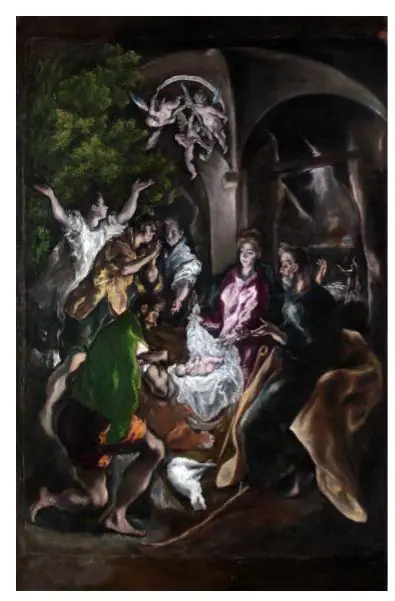
Adoration of the Shepherds by El Greco celebrates the story of the shepherds who came to visit the baby Jesus after he was born. El Greco, whose name means The Greek, painted this scene in 1614, the last year of his life. It is rendered in his unmistakable signature style, with elongated limbs and dramatic, almost otherworldly lighting that seems to pour out of the Christ child himself. That glow is not an accident. It is the whole point of the painting, drawing every figure and every eye toward the newborn at the center.
Adoration of the Shepherds by El Greco. Photo courtesy of Wikipedia.
The Annunciation by Leonardo da Vinci
The Annunciation by Leonardo da Vinci tells the moment just before Christmas: the Angel Gabriel appearing to Mary to tell her she would be the mother of Jesus. Da Vinci took the scene from the Book of Luke. He is thought to have painted it sometime between 1472 and 1475, while he was still a young artist under the tutelage of his master, Andrea del Verrocchio. He worked it in oil and tempera on panel, and many consider it one of his early masterworks. You can already see the careful observation and quiet naturalism that would define everything he made afterward, which makes more sense once you understand Leonardo da Vinci’s apprenticeship and how he learned to paint.
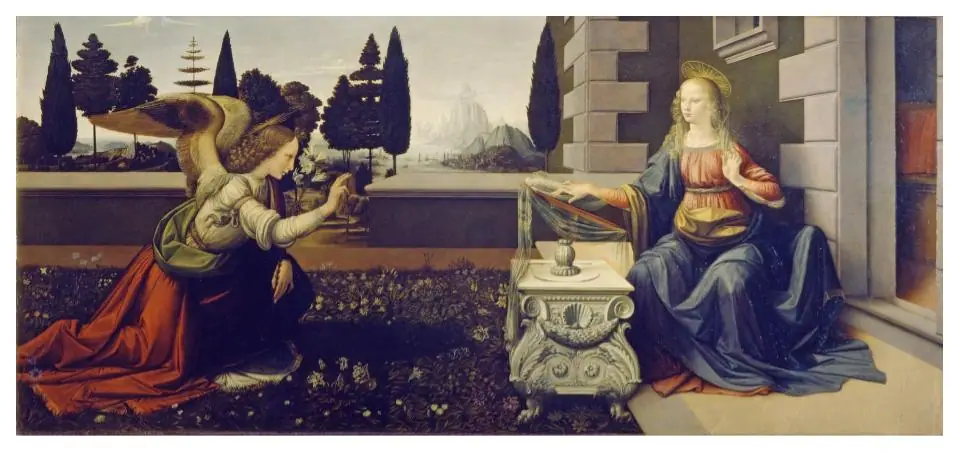 The Annunciation by Leonardo da Vinci. Photo courtesy of Wikipedia.
Snow Scene at Argenteuil by Claude Monet
Snow Scene at Argenteuil by Claude Monet proves that not every Christmas painting is religious. Painted in 1875, it takes us to a snowy day in a French town long ago, with figures moving through falling snow under a soft, muffled sky. There is no nativity here, no angel, no Christ child. There is only winter, and yet it feels like the season completely. Monet’s loose brush strokes and careful choice of colors capture the fleeting nature of both the light and the snow, the way a snowfall looks different minute to minute. If you want to understand how he saw light this way, these Claude Monet facts trace how he helped start Impressionism.
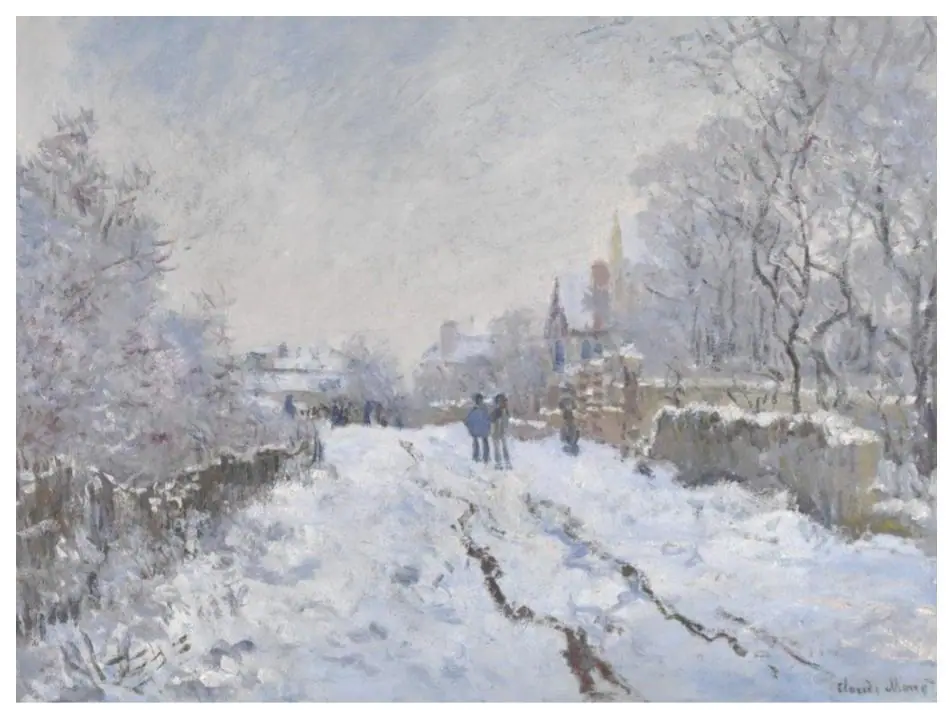 Snow Scene at Argenteuil by Claude Monet. Photo courtesy of Wikipedia.
The Sistine Madonna by Raphael
The Sistine Madonna by Raphael is an altarpiece commissioned in 1512 by Pope Julius II, and it counts among Raphael’s last paintings. It is an oil painting on canvas, made to honor Pope Julius II’s uncle, Pope Sixtus IV. The Virgin holds the Christ child at the center, flanked by saints, and the whole composition draws your eye upward in the calm, balanced way Raphael was famous for. The two small winged figures at the bottom edge have since become some of the most reproduced figures in all of art, even by people who have never heard the painting’s name.
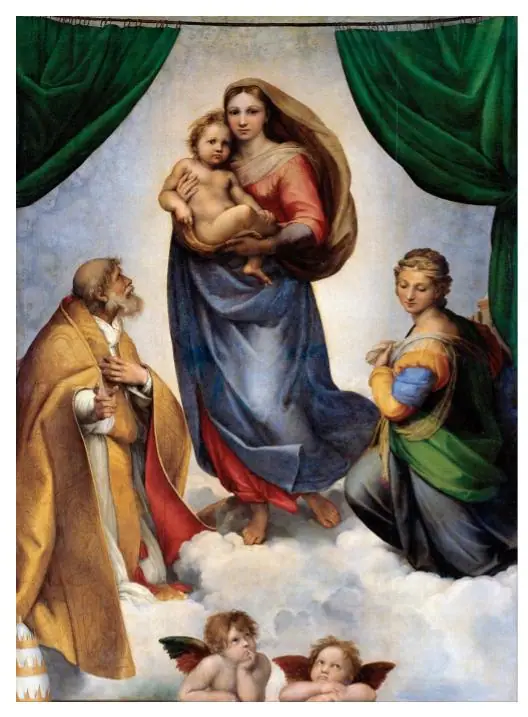 The Sistine Madonna by Raphael. Photo courtesy of Wikipedia.
Nativity with St Francis and St Lawrence by Caravaggio
Nativity with St Francis and St Lawrence by Caravaggio, painted in 1600, is both a famous Christmas painting and one of art history’s great mysteries. The scene shows the Christ child on the ground, surrounded by figures that include Saint Lawrence and Saint Francis of Assisi, all lit in Caravaggio’s signature deep shadow that pulls the holy moment out of the darkness. Then the story turns: the painting was stolen from the Oratory of Saint Lawrence in Palermo, Italy in 1969 and has never been recovered. The FBI considers the theft one of the top art crimes in history. If that dramatic light is what catches your eye, here is how Caravaggio lit a world without electricity.
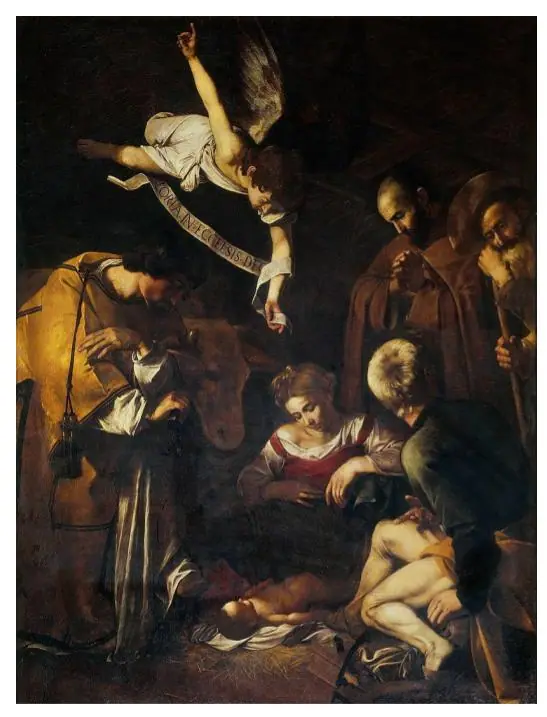 Nativity with St Francis and St Lawrence by Caravaggio. Photo courtesy of Wikipedia.
Why did famous artists paint Christmas scenes?
Famous artists painted Christmas scenes because, for most of history, paintings were how the story was told at all. Only a select few could read, so the church leaned on artists to convey the stories of the Bible to people who would never open a book. A nativity above an altar was not decoration. It was the page everyone could read. This is one reason so many of these works double as narrative art, images built to carry a story to a viewer.
Even after literacy spread, painters kept returning to Christmas, and you can feel why in these five works. The season gave them everything a great painting wants: a child at the center of glowing light, the tension of an angel’s visit, the hush of snow, the drama of shadow. Looking closely at how each artist handled that light and meaning is exactly the kind of attention that makes you a better painter yourself, which is part of why studying art history is worth your time.
The honest invitation here is simple. You do not have to be a Renaissance master to start putting light and feeling onto a surface. If these paintings make you want to pick up a brush this season, our free Two Week Challenge is a guided way to make your first real paintings instead of only admiring everyone else’s. When you want to keep exploring, the rest of our art history and famous paintings collection is here.
Frequently asked questions
What are the most famous Christmas paintings?
Five of the most famous Christmas paintings are El Greco's Adoration of the Shepherds, Leonardo da Vinci's The Annunciation, Claude Monet's Snow Scene at Argenteuil, Raphael's Sistine Madonna, and Caravaggio's Nativity with St Francis and St Lawrence. Some depict scenes from the nativity story, while others capture the winter light and quiet feeling that people associate with the season.
Who painted famous Christmas paintings?
Many of the most celebrated artists in history painted Christmas and nativity subjects, including El Greco, Leonardo da Vinci, Raphael, and Caravaggio. Claude Monet painted the season without religious subject matter, capturing a snowy French day instead. For centuries, painters carried the Christmas story to people who could not read, which is why so many masters returned to it.
Why did famous artists paint Christmas scenes?
For most of history only a small number of people could read, so church leaders relied on artists to tell the stories of the Bible through paintings, sculptures, and altarpieces. Christmas and nativity scenes were among the most commissioned subjects. Even after literacy spread, painters kept returning to the season for its drama, its light, and its meaning.
Are all famous Christmas paintings religious?
No. Many famous Christmas paintings depict the nativity or the annunciation, but others simply celebrate what people came to associate with the season. Claude Monet's Snow Scene at Argenteuil has no religious subject at all. It captures a fleeting snowy day in France, and its winter light is what makes it feel like Christmas.
Which famous Christmas painting was stolen?
Caravaggio's Nativity with St Francis and St Lawrence, painted in 1600, was stolen from the Oratory of Saint Lawrence in Palermo, Italy in 1969 and has never been recovered. The FBI considers the theft one of the top art crimes in history, which has made the painting one of art history's enduring mysteries.
What to practice this week
- Pick one of these five paintings and copy a small section of it, focusing only on how the artist handled light and shadow rather than the whole composition.
- Study Monet's Snow Scene and try a quick value study of a winter photo using only black, white, and gray, so you learn to see snow as light before you reach for color.
- Look at the dramatic lighting in the El Greco and Caravaggio, then set up a single object under one lamp and paint the way the light falls across it.
Supplies used

About the author
More from Elli