Famous Acrylic Paintings: 8 Modern Works That Defined the Medium
Acrylic is the youngest of the major paints, so its masterpieces are modern. Here are the famous acrylic paintings worth knowing, and the famous ones that are secretly oil.

The most famous acrylic paintings are all modern, and that is not an accident. Acrylic paint for artists did not exist until the mid 20th century, so the medium has no old masters. Its landmark works belong to Pop art, color field painting, and the contemporary art of the last few decades. The best known include Andy Warhol’s Marilyn Diptych, David Hockney’s A Bigger Splash, Roy Lichtenstein’s Whaam!, Frank Stella’s Harran II, Julie Mehretu’s Mural, Takashi Murakami’s 727, and KAWS’s The KAWS Album.
Acrylic rewarded a particular kind of painting: flat, bold, fast, and graphic. It dries in minutes instead of days, it stays bright without yellowing, and it lays down even fields of color that oil struggles to match. The artists below built whole styles on those properties. If you want to understand how acrylic differs from the older medium it competes with, our guide to the key differences between acrylics and oil paint is the place to start.
Andy Warhol, Marilyn Diptych (1962)
Marilyn Diptych is silkscreen ink and acrylic paint on canvas, and it is probably the single most famous acrylic work in the world. Warhol made it weeks after Marilyn Monroe’s death, repeating one publicity photo across fifty panels. The left half blazes with acrylic color, the right half fades to black and white, and the contrast reads as fame and mortality side by side. Acrylic was the right tool here: it gave Warhol fast, flat, poster bright color under the printed image. The painting is held at Tate Modern in London.
David Hockney, A Bigger Splash (1967)
A Bigger Splash is acrylic on canvas, and it is the painting most people picture when they think of Hockney. A modern California house, an empty diving board, and a white burst of splash frozen against a calm blue pool. Hockney used acrylic precisely because of its flat, untextured finish. The pool and sky are smooth planes of even color, and the chaotic splash, which he painted slowly with small brushes, is the one place the surface comes alive. It lives at Tate Britain.
Roy Lichtenstein, Whaam! (1963)
Whaam! is a two panel painting based on a comic book panel, showing a fighter jet firing a rocket into an exploding enemy plane. One honest note on the medium: Lichtenstein painted it in Magna and oil. Magna is an acrylic resin paint, an early solvent based acrylic, so the work is part acrylic and part oil rather than pure water based acrylic. Either way it shows what the new paint could do, holding the hard edges, flat primaries, and printed dot pattern that defined his Pop style. Whaam! is at Tate Modern.
Frank Stella, Harran II (1967)
Harran II is a large canvas of interlocking arcs and bright bands, made with polymer and fluorescent polymer paint. Polymer paint was the period name for acrylic, so Harran II is an acrylic painting in everything but vocabulary. Stella used the medium’s flat, industrial finish to make color and geometry the entire subject of the work, with no illusion of depth at all. It belongs to the Solomon R. Guggenheim Museum in New York.
Julie Mehretu, Mural (2009)
Mehretu’s Mural is ink and acrylic on canvas, and at roughly eighty feet long it is one of the most ambitious acrylic works of the contemporary era. Commissioned for the lobby of a major bank headquarters, it layers maps, architectural plans, and bursts of abstract mark making into a single dense field. Acrylic let Mehretu build that density in transparent, fast drying layers without the long waits oil would have demanded.
Takashi Murakami, 727 (1996)
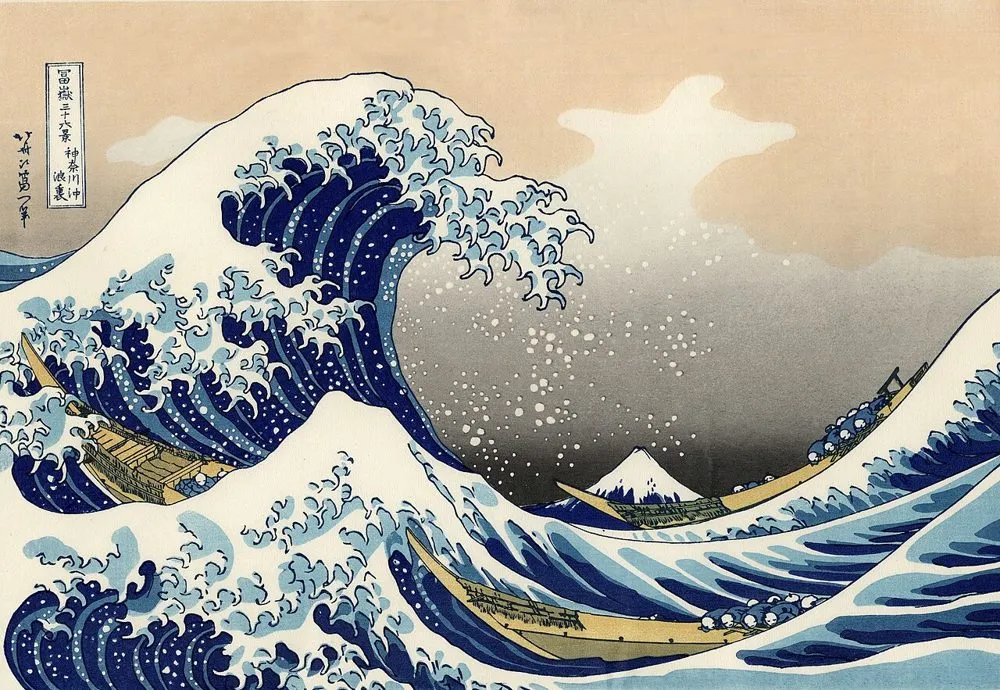
727 is acrylic on canvas mounted on board, in three panels, and it helped launch Murakami onto the international stage. His grinning avatar Mr. DOB rides a stylized wave painted in the flat, glossy, anime influenced style he calls Superflat. Acrylic is central to that look, giving the slick, even, almost printed surface the work depends on. It is held at the Museum of Modern Art in New York.
KAWS (Brian Donnelly), The KAWS Album (2005)
The KAWS Album is acrylic on canvas, and it set a record when it sold at auction in Hong Kong in 2019 for nearly fifteen million dollars. It reimagines the cover of a famous Beatles record with the artist’s cartoon Companion figures in place of the band. The flat, clean, commercial finish that made the sale a headline is pure acrylic, the same paint a beginner can buy at any art store.
Shepard Fairey, Hope (2008)
Fairey’s Obama Hope image became one of the most recognized pieces of art of its decade. A precise note matters here: the version most people know is a printed poster, while the unique original held at the National Portrait Gallery is a mixed media work, collage and stencil with acrylic on paper. So Hope is acrylic, but it is acrylic as part of a layered, hand finished piece rather than a straight painting on canvas.
Alexa Meade, painting on living subjects
Alexa Meade is the contemporary outlier worth knowing. She paints directly onto people and real objects with acrylic, then photographs the result, so a living person ends up looking like a flat, brushy portrait. There is no single canonical canvas to point to, because the painting is the photograph of the painted scene. Her medium is genuinely acrylic, chosen because it is safe enough for skin and dries fast enough to hold a pose.
Famous paintings people think are acrylic, but are not
Part of knowing art history is knowing what is true, so here is the correction that trips up most people. Two of the works most often called acrylic are actually oil.
Helen Frankenthaler’s Mountains and Sea (1952) is the classic example. It looks like soft, soaked stains of acrylic, and it inspired a whole generation of acrylic painters, but the work itself is oil thinned with turpentine. Frankenthaler invented her soak stain technique in oil first. Mark Rothko is the other one. His glowing color field paintings are usually assumed to be flat acrylic, but his signature works are oil, sometimes mixed with egg and glue, not acrylic at all.
The lesson for a working artist is simple: do not assume a flat, modern looking painting is acrylic, and do not trust a caption you have not checked. The same care you bring to your own color mixing is the care art history deserves.
Why acrylic has no old masters
Acrylic feels like it has been around forever because it is the first paint most of us ever touch. It has not. Oil painting goes back centuries, which is why our list of famous historical oil paintings reaches from the Renaissance to the modern era. Acrylic’s whole story fits inside living memory, which means the medium is still young enough that its masterpieces are being made right now.
That is the encouraging part. The famous acrylic paintings of the next fifty years have not been painted yet, and acrylic is the most forgiving, beginner friendly paint there is. If you want to put your own work into that story, start by learning the craft properly. You can explore the whole art history and famous paintings collection to see where the medium came from, then dig into oil painting techniques and acrylic skills to build the foundation underneath it.
Frequently asked questions
What is the most famous acrylic painting?
Andy Warhol's Marilyn Diptych (1962) is arguably the most famous acrylic painting, made with silkscreen ink and acrylic on canvas and now held at Tate Modern. David Hockney's A Bigger Splash (1967) and Roy Lichtenstein's Whaam! (1963) are close rivals for the title.
When was acrylic paint invented?
Acrylic paint for artists arrived in the mid 20th century. A solvent based acrylic called Magna appeared in the late 1940s, and water based artist acrylics came to market in the 1950s. That is why every famous acrylic painting is modern: the medium simply did not exist before then.
Did Andy Warhol use acrylic?
Yes. Warhol combined acrylic paint with silkscreen printing. His Marilyn Diptych and many of his Pop portraits are acrylic and silkscreen ink on canvas, which let him lay down flat, saturated color fast and then print the photographic image on top.
Are famous paintings like Mountains and Sea acrylic?
No, and this is a common mistake. Helen Frankenthaler's Mountains and Sea (1952) is oil thinned with turpentine, not acrylic. Many works people assume are acrylic, including most of Mark Rothko's color fields, are actually oil.
What to practice this week
- Pick one famous acrylic painting above and study how the artist used acrylic's fast drying time and flat, even color to their advantage.
- Try a small color block study in acrylic, then the same study in oil, and notice how differently each medium behaves.
Supplies used
About the author
More from Elli