Minimalism in Art History: The Movement Where Less Became More
Minimalism stripped art down to its essentials: form, space, color, and intention. Here is what the movement is, where it came from, and the artists who defined it.

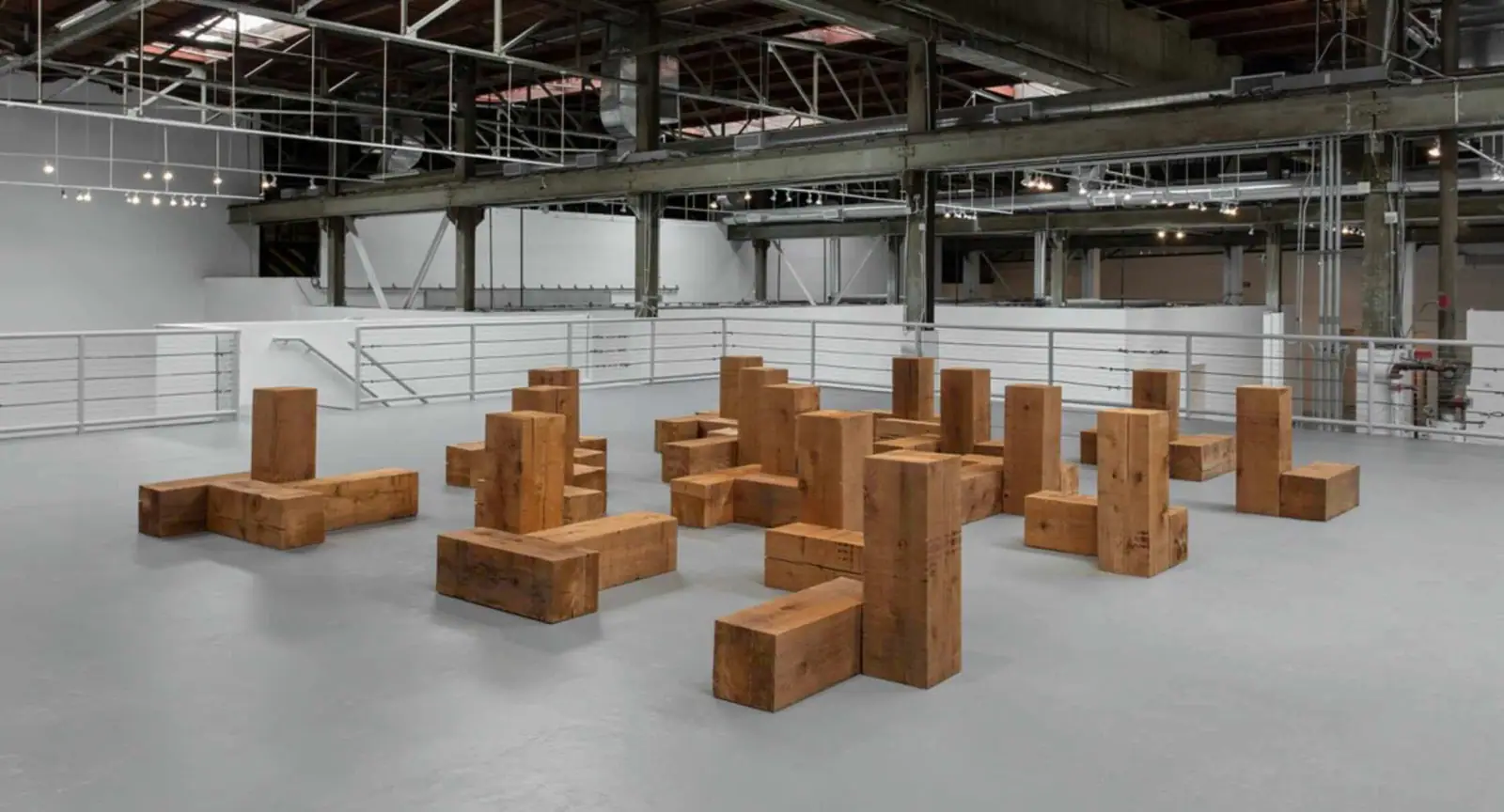
Minimalism is a mid twentieth century art movement that reduced art to its essential elements: simple geometric form, restrained color, and deliberate space. It emerged in the United States in the late 1950s and 1960s, and it was a direct reaction against the emotional, gestural painting that came before it. Where earlier artists wanted you to feel their inner world, Minimalists wanted the work to simply exist, an object with nothing added, nothing accidental, and nothing to decode. The phrase that has followed the movement ever since says it plainly: less is more.
That idea sounds simple, and that is the point. Minimalist art strips away detail so the eye can rest on what actually matters: form, space, balance, and intention. Clean lines, basic geometric shapes, and quiet color work together to make art that feels calm, deliberate, and deeply focused. This guide walks through what Minimalism is, where it came from, the principles underneath it, and the artists who proved that restraint could be just as powerful as abundance. If movements are your interest, you may also like how pop art took the opposite road at almost the same moment in history.
What is Minimalism in art?
Minimalism is about reducing art to its essential elements, with nothing added and nothing accidental. Shapes are simple, compositions are intentional, and every decision serves a purpose. Instead of depicting a recognizable subject or telling a story, the artwork invites you to engage directly with form, proportion, and space. The result feels grounded, balanced, and quietly powerful.
Minimalist artists frequently work with geometric forms such as squares, rectangles, and lines, paired with neutral or softly contrasting color. There is no symbolism to interpret and no hidden narrative. What you see is genuinely what you get, and that honesty is the whole idea. A Minimalist object refuses to pretend to be anything other than itself.
Negative space is just as important as the forms themselves. The space surrounding a shape lets the work breathe and asks you to pause, notice small details, and feel the strength in restraint. In a busy painting your eye races. In a Minimalist work it slows down, and that slowing is part of the experience the artist designed.
Where did Minimalism come from in art history?
Minimalism emerged in the United States in the late 1950s and through the 1960s as a deliberate reaction against Abstract Expressionism. The generation before, painters like Jackson Pollock and Willem de Kooning, had made art that was gestural, emotional, and intensely personal. Every drip and slash was meant to carry the artist’s inner life. Minimalists wanted the exact opposite.
They wanted work that was cool, factual, and impersonal. No emotion to perform, no autobiography, no hidden meaning. The object should be what it is, made of real materials, occupying real space. Many Minimalists embraced industrial fabrication and repetition precisely because those things felt neutral and removed the artist’s ego from the surface. This was art history swinging hard in the opposite direction, trading heat for clarity. To see how often the story of art works this way, one movement reacting against the last, it helps to understand why study art history at all.
What are the core principles of Minimalism?
Minimalism rests on a handful of clear principles, and naming them makes the movement easy to recognize anywhere you meet it.
- Simplicity. Art is reduced to its essential elements. If a line, shape, or color is not doing necessary work, it is removed.
- Geometric form. Squares, rectangles, bars, grids, and lines do most of the work. Recognizable imagery is set aside in favor of pure shape.
- Restrained color. Palettes stay neutral or quietly contrasting. Color is used with discipline, never for decoration.
- Repetition. Identical units repeated at even intervals create rhythm and order, and let you experience the work as structure rather than picture.
- Negative space. The empty area around a form is treated as an active part of the composition, not leftover background.
- Intention. Nothing is accidental. Every placement, interval, and proportion is a deliberate choice, which is why small shifts change the entire feeling of a piece.
Minimalism is not about emptiness. It is about intention. By removing distractions, the artist builds an experience of clarity and presence, and asks you to engage on a slower, more attentive level. Calm, balance, and stillness in a Minimalist work are not accidents. They are carefully constructed through disciplined decisions, the same disciplined decisions any painter makes when working with the 7 elements of art.
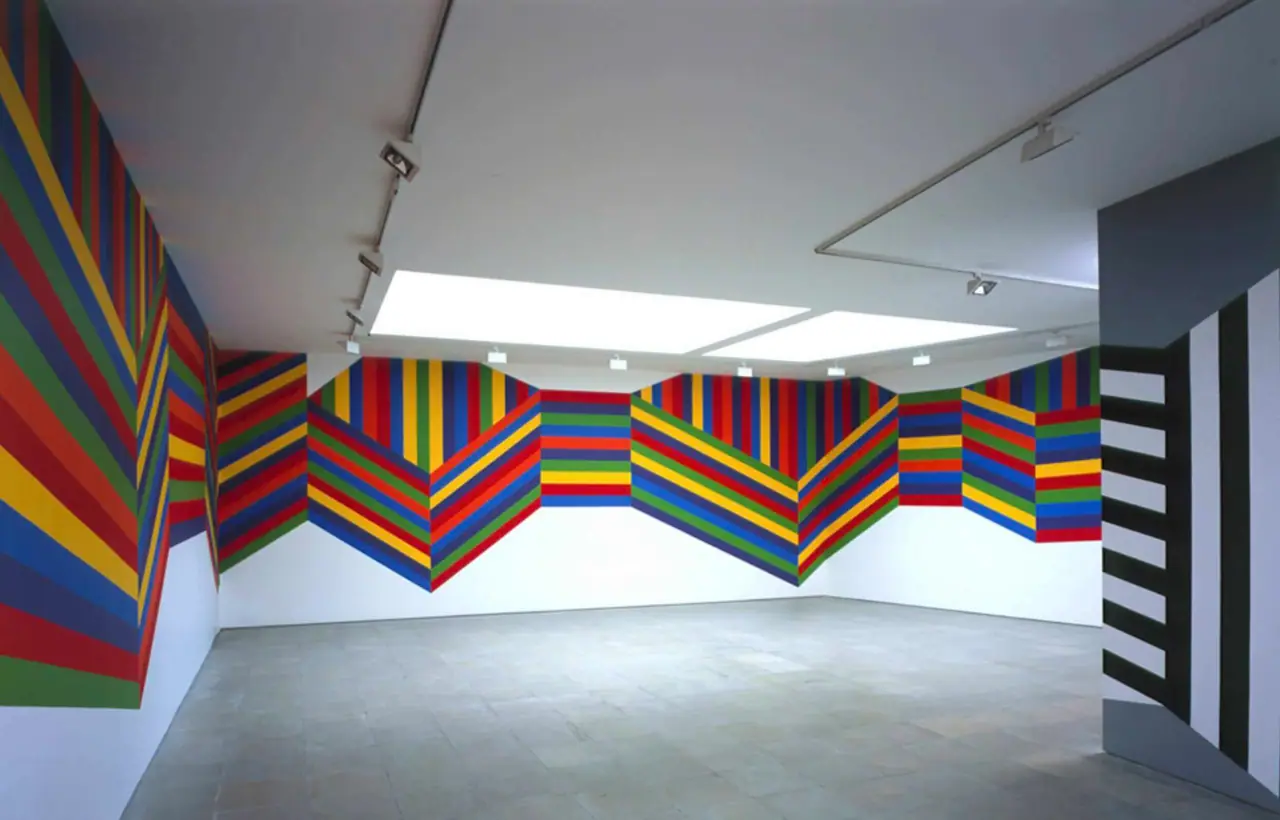
Sol LeWitt pushed this thinking even further. He often wrote out instructions for wall drawings that assistants then executed, treating the idea behind the work as the real art. The result, like his Wall Drawing #1138 above, is pure form and color carried out with precision, the personality of any single hand deliberately removed.
Who are the most important Minimalist artists?
Donald Judd, Agnes Martin, Frank Stella, Carl Andre, Sol LeWitt, and Dan Flavin are among the artists who defined Minimalism. Their approaches differ, but each one shows how simplicity can carry real weight. Two of them in particular reveal the range the movement could hold.
Donald Judd
Donald Judd is known for precise, three dimensional works that emphasize repetition, structure, and clarity. His Untitled (Stack) from 1967 is a vertical arrangement of identical rectangular forms mounted on the wall at even intervals. The repetition creates rhythm and order, and lets you experience the piece as a physical presence rather than a representation of something else.
%20(1967).jpg)
Judd believed art did not need symbolism or narrative. It should simply exist. He even resisted the word sculpture, preferring to call his pieces specific objects. His work asks you to engage with shape, material, and space exactly as they are, with nothing standing in for anything else.
Agnes Martin
Agnes Martin offers a softer, more meditative side of Minimalism. Her paintings feature delicate grids, faint lines, and gentle, washed color. In works like Untitled #5 from 1998, she uses repetition and restraint to evoke feelings of peace, harmony, and quiet joy. Stand close and the surface is full of tiny human variations in each hand drawn line.
.jpg)
Martin believed simplicity could express emotion without any image at all. Her work proves that Minimalism does not have to feel cold. Through balance, rhythm, and sensitivity, it can connect with a viewer as deeply as any portrait. Together, Judd and Martin show the breadth of the movement: one building hard industrial order, the other coaxing tenderness out of a grid.
How did Minimalism shape and stretch?
Minimalism did not stay in one lane, and a few artists pushed its logic in surprising directions. Frank Stella, often associated with the movement’s early days, made flat, hard edged paintings on shaped canvases. His Tahkt-i-Sulayman Variation II from 1969 takes the Minimalist love of geometry and runs it through bright interlocking arcs, showing how reduction and order could still produce something dazzling.
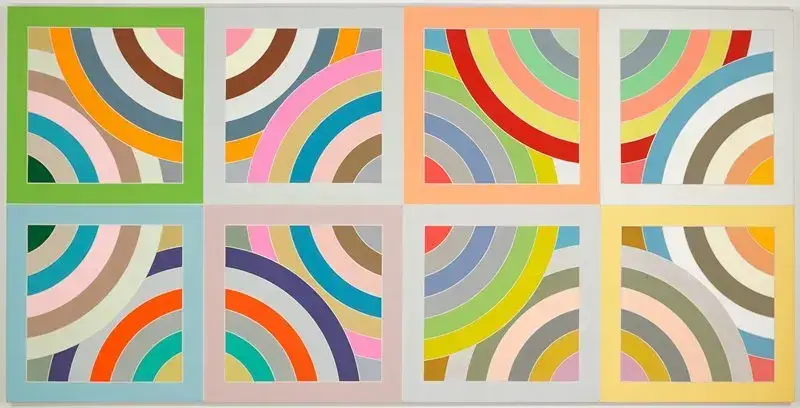
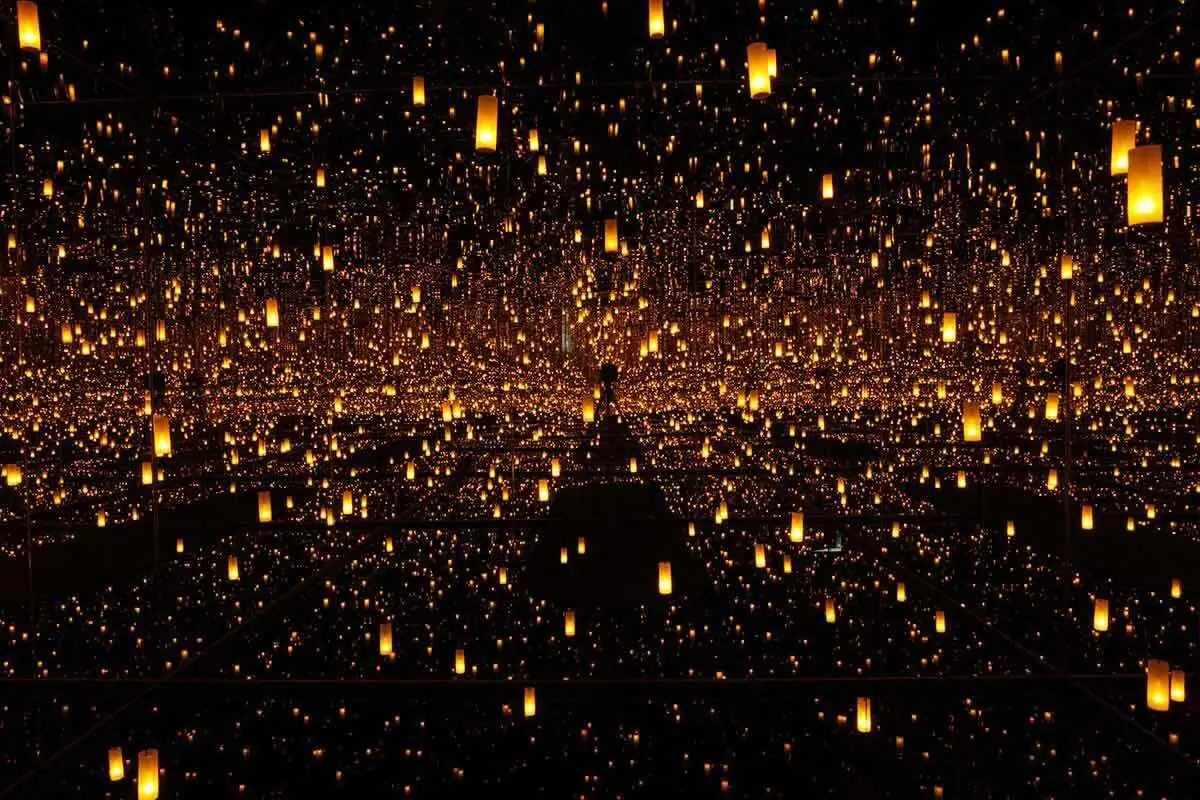
His work captures the Minimalist insistence on art as a literal object, a flat painted surface and nothing hidden behind it. Other artists carried the principle of repetition into immersive territory. Yayoi Kusama, working with obsessive repetition and mirrored space, built rooms where simple repeated points of light multiply into something endless, turning Minimalist restraint into total environment.
The lesson across all of them is the same. Meaning does not come from complexity. It comes from clarity. By focusing on essential form and carefully considered space, these artists made work that feels intentional, serene, and timeless. The discipline behind that, being thoughtful with every single choice, is exactly the discipline that strengthens any artist’s ability to communicate with confidence. You can see a related kind of bold reduction at work in these famous acrylic paintings from the same modern era.
Why does Minimalism still inspire artists today?
Minimalism’s influence reaches far beyond the gallery. You see its principles in architecture, interior design, fashion, product design, and digital interfaces. Clean lines, open space, and intentional design have become hallmarks of modern creativity, so much so that we often do not notice we are looking at a movement that began in the 1960s.
In a world full of noise and distraction, Minimalism offers calm and focus. It encourages a kind of mindfulness, and reminds us that we do not always need more to experience beauty. Sometimes less is exactly enough. For a working artist, that mindset is practical, not just philosophical.
Minimalism is a valuable practice at any stage of your journey. By working with fewer elements, you sharpen your ability to see clearly, make confident decisions, and build balanced compositions. It trains your awareness of form, proportion, and space, and those skills carry into every kind of art you might make later. You do not have to commit to the style forever to learn from it. Even a few deliberately reduced studies will change how you see everything else you paint, the same way understanding a movement like post-impressionism sharpens how you read color and brushwork.
Embracing the Minimalist mindset
Minimalism reminds us that every line matters and every shape has a purpose. Through simplicity, art becomes direct, honest, and clear. When you embrace a Minimalist approach, you learn to trust restraint, to value space, and to find meaning in what remains rather than in what you can add.
That is a skill worth building no matter what you ultimately want to paint. The strongest artistic statement is often the one that says just enough and no more. If you want a guided, supported way to start training your eye and your decisions as an artist, our free Two Week Challenge is built for exactly that first step, and the rest of our art history and famous paintings collection is here whenever you want to keep exploring how movements like this one came to be.
Frequently asked questions
What is minimalism in art history?
Minimalism is a mid twentieth century art movement that reduced art to its most essential elements: simple geometric form, restrained or neutral color, and carefully considered space. It emerged in the United States in the late 1950s and 1960s as a reaction against the emotional excess of Abstract Expressionism. Instead of telling a story, the work was meant to exist as a pure, self contained object.
Who are the most important Minimalist artists?
Donald Judd, Agnes Martin, Frank Stella, Carl Andre, Sol LeWitt, and Dan Flavin are among the defining figures of Minimalism. Judd built repeating three dimensional units, Martin painted quiet grids, Stella made flat shaped canvases, and Flavin worked in fluorescent light. Each stripped art down to form, material, and space rather than symbolism or narrative.
What are the core principles of Minimalism?
Minimalism rests on simplicity, repetition, geometric form, restrained color, and the deliberate use of space. Negative space matters as much as the object itself. Nothing is added for decoration and nothing is accidental, so every line, shape, and interval is chosen on purpose. The goal is clarity and presence rather than storytelling or emotional display.
When did Minimalism start and why?
Minimalism emerged in the United States in the late 1950s and through the 1960s. It grew as a deliberate reaction against Abstract Expressionism, which prized gesture, emotion, and the painter's inner life. Minimalist artists wanted the opposite: cool, impersonal, factual work where the object simply is what it is, with no hidden meaning to decode.
What is the difference between Minimalism and Abstract Expressionism?
Abstract Expressionism was emotional, gestural, and personal, putting the artist's hand and feeling at the center. Minimalism rejected all of that. It favored clean geometry, industrial materials, repetition, and a cool, impersonal finish. Where Abstract Expressionism asked you to feel the artist, Minimalism asked you to simply experience the object as it is.
What to practice this week
- Make a value study using only three flat tones and a few hard edged geometric shapes, and arrange them so the empty space carries as much weight as the shapes.
- Choose one simple form, a square, a bar, a circle, and repeat it across a surface at even intervals to feel how rhythm and order alone can hold a composition.
- Take a finished piece you find busy and remove elements one at a time until taking away one more would break it. That edge is what Minimalists trained for.
Supplies used
About the author
More from Elli