Narrative Art: What It Is and How Paintings Tell a Story
A narrative painting captures one frame of a larger story and lets the viewer imagine the rest. Here is what narrative art is, why it pulls people in, and how to paint one.

Narrative art is visual art that tells a story. Instead of simply showing a subject, a narrative painting captures one charged moment from a larger story, a single frame pulled from a whole movie, and leaves the rest open so the viewer imagines what happened before and what comes next. That unanswered question is the whole trick. It is what makes a person stop walking, lean in, and keep looking. The painting raises a question, and the viewer cannot help but try to answer it.
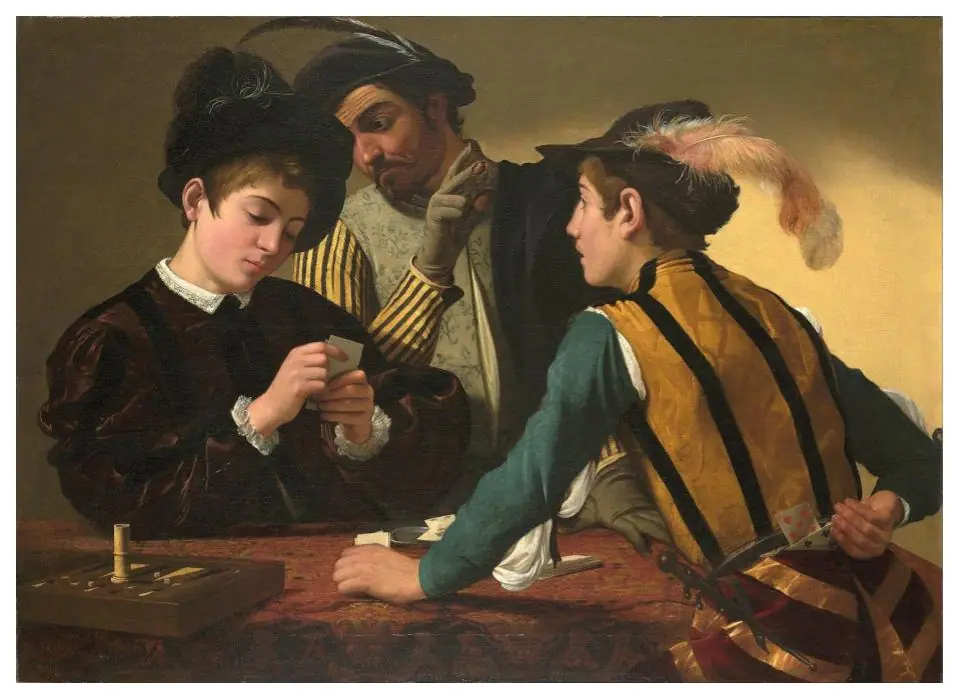
As the old saying goes, a picture is worth a thousand words. So even though we usually think of stories as made of words, a single painting can hand the viewer a moment so loaded that they write the rest of the story themselves. Look at the painting below by Caravaggio. A young man is being cheated at cards. You can see the cheating happening, but you do not know how it ends. That gap is exactly where you, the viewer, get pulled in.
What is narrative art?
Narrative art is art that tells a story, a visual story rather than a written one. It does something a portrait or a still life does not: it makes the viewer ask a question and want to know more. The story is not bound by the four sides of the canvas. It expands and moves beyond the frame, into the part of the story you imagine for yourself.
The clearest way to understand it is to think of a single frame lifted from a full length movie. You are seeing just one moment out of the entire storyline, and that limitation is a feature, not a flaw. Because you only see one scene, you fill in everything around it: what led to this moment, and what will happen once it passes. Every viewer adds a slightly different version of the rest of the story, which is why two people can stand in front of the same narrative painting and walk away having seen two different tales. The artist creates the scene. The viewer creates the story.
What is a narrative painting?
A narrative painting is a painting that tells a story by showing one frame of it. It captures a moment of action or emotion and deliberately leaves the surrounding events unseen, so the image keeps living in the viewer’s mind after they look away. The Caravaggio above is a textbook case. The scene is in motion, the deception is underway, and the outcome belongs to you.
What separates a narrative painting from an ordinary depiction is that sense of before and after. A static pose just sits there. A narrative scene clearly came from somewhere and is heading somewhere, and that momentum is what makes the viewer feel they have walked in on the middle of something. The figures have a history together. Something is at stake. The painting trusts the viewer to feel all of that without spelling it out.
How is narrative art different from illustration?
Narrative art and illustration are close cousins, but they pull in opposite directions. Illustration usually depicts a story that already exists and shows the scene as it was written, answering the viewer’s questions and confirming what they already know. Narrative art suggests a story without ever fully telling it, leaving the events open so the viewer invents what happened. Illustration tends to answer. Narrative painting tends to ask.
That difference matters when you sit down to make your own work. If you nail down every detail and close off every question, you have made an illustration of a story only you know. The piece becomes specific in a way that shuts the viewer out. The more open ended you keep it, the more room the viewer has to step inside and make the story theirs. The two forms overlap, and plenty of great images live in the gray area between them, but the open question is what tips a piece toward narrative art.
How do you paint a narrative painting?
You paint a narrative painting by asking questions, because questions are the real tool here. You are the artist, which makes you the director of this movie, and a director starts by interrogating the scene before a single brush touches the canvas. Work through these before you paint:
- What story are you telling? Know the larger story in your own head, even though you will only show one slice of it.
- Which single scene will you paint? Choose the one charged moment that carries the most weight. Usually it is a turning point, not a beginning or an ending.
- What happens before and after? Hold both in mind. The momentum of the scene depends on it, even though neither appears on the canvas.
- Which characters belong in the frame? Decide who is present and what their relationship to one another is.
- What are they doing? Action and gesture are how a still image suggests movement and consequence.
- What is your focal point? Pick the place you want the viewer to land at first glance.
- How will you move the viewer’s eye? Plan the path their gaze travels through the painting so the story unfolds in the order you intend.
Once you know where you are going, make sure the painting stays open ended. The trap is making it so specific that you become the only person who knows the true story. It is almost arrogant to create something so strange and elusive that the viewer feels lost. The goal is the opposite: to spark their imagination, draw them into the scene, and provoke their curiosity to know more. When a viewer becomes so invested in their own interpretation that they do not want to part with the piece, that is also, quietly, a great selling point.
All of this takes practice, and a lot of it. The way to build real skill is to paint a lot, and narrative painters often spend even more time at the easel than most, because pulling off a strong story painting demands genuine craft. Knowing how to lead the eye, how to stage action, how to use line to create movement and how to handle the 7 elements of art all feed into it. Narrative work also asks you to get into the right headspace, to explore your own thoughts and dreams and dare to put a story of your own on canvas. Then do it again. And again. Do not be hard on yourself if it comes slowly. That is just part of the journey.
What are some famous narrative paintings?
Many of art history’s most famous works are narrative paintings, because the impulse to tell a story in a single image is as old as painting itself. A few examples make the pattern clear:
- The Cardsharps by Caravaggio. A young man is cheated at cards while an accomplice signals his hand. The scene is all tension and no resolution, lit like a stage, and Caravaggio’s dramatic lighting does as much storytelling as the figures do.
- Freedom From Want by Norman Rockwell. Rockwell built entire stories into ordinary moments. A family gathered at a table becomes a story about belonging, abundance, and home, and you can read the full story of Freedom From Want and what it meant.
- Old Master scenes of myth and scripture. For centuries, painters used narrative to depict gods, heroes, and sacred moments, freezing a story everyone in the room would recognize. Browse a survey of famous paintings that shaped art history and you will find narrative everywhere.
The thread running through all of them is the same one you started with: a single captured moment that implies a much larger story. None of these paintings shows you everything. Each one shows you enough.
Final thoughts on narrative art
Create your story, be expressive, and show action and emotion in your work. Your characters have a story to tell, but in your painting they only get to reveal one scene of it, so leave the rest open. Let the viewer ask questions. Let them imagine an ending that belongs to them. That openness is not a weakness in the work. It is the engine that pulls people in and keeps them looking.
Be persistent as you keep practicing, and do not give up. Your skill will grow with every piece you make, and your stories will get sharper and stranger and more your own. If you want a structured place to start putting stories on canvas, our free Two Week Challenge is a guided way to make your first paintings instead of just reading about them. And when you want to keep exploring how the great painters told stories, the rest of our art history and famous paintings collection is here.
Frequently asked questions
What is narrative art?
Narrative art is visual art that tells a story. Instead of simply showing a subject, a narrative painting captures a single charged moment from a larger story and invites the viewer to imagine the rest. The story is not contained by the four edges of the canvas. It expands outward into what the viewer pictures happening before and after the scene.
What is a narrative painting?
A narrative painting is a painting that tells a story by showing one frame of it, like a single still pulled from a movie. It captures a moment of action or emotion and leaves the surrounding events open, so each viewer adds their own interpretation. Caravaggio's The Cardsharps is a well known example: a young man is being cheated at cards, and the outcome is left to you.
What makes a painting tell a story?
A painting tells a story when it shows a moment that clearly came from somewhere and is heading somewhere, rather than a static pose. Action, emotion, and the relationships between figures all suggest events beyond the frame. The strongest story paintings stay open ended on purpose, raising a question the viewer wants to answer instead of explaining everything.
How is narrative art different from illustration?
Illustration usually depicts a story that already exists and shows the scene as written. Narrative art suggests a story without spelling it out, leaving room for the viewer to invent what happened. Illustration tends to answer questions, while narrative painting asks them. The two overlap, but the open ended quality is what makes a piece read as narrative art.
Who are some famous narrative artists?
Many of art history's best known painters worked in narrative. Caravaggio staged dramatic, story driven scenes lit like a stage. Norman Rockwell built entire stories into single everyday moments. Old Master painters across centuries used narrative to depict myth, scripture, and daily life. The common thread is a single captured moment that implies a much larger story.
What to practice this week
- Pick a story you know well, then choose the single most charged moment in it. Not the beginning or the end, the turning point. That one frame is what you will paint.
- Before you paint, answer these on paper: what happened just before this scene, what happens just after, and what question do you want the viewer to ask. Keep the painting open enough that the answer is theirs, not only yours.
- Plan your focal point and the path the viewer's eye will travel. Decide where they look first, then how you lead them through the rest of the scene so the story unfolds in the order you intend.
Supplies used
About the author
More from Elli