Freedom From Want by Norman Rockwell: The Story and Meaning Behind the Painting
The Thanksgiving painting that helped a hesitant nation picture what it was fighting for, and the quiet choices that make it work.

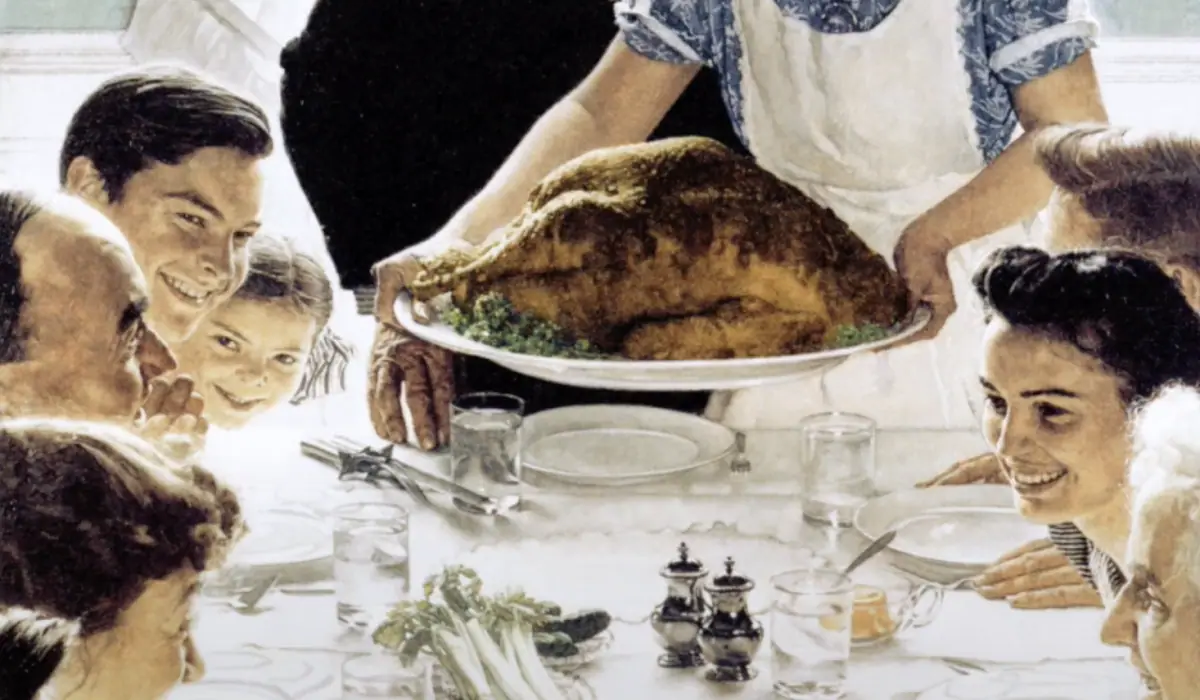
Freedom From Want is a 1943 oil painting by Norman Rockwell showing a family gathered around a holiday table as the grandmother lowers a roasted turkey into place. It is one of Rockwell’s four paintings illustrating Franklin Roosevelt’s Four Freedoms, and it has become so tied to the American Thanksgiving that most people picture it without ever knowing its name. This guide walks through where the painting came from, who posed for it, what it actually means, and the quiet craft decisions that make it work.
What is Freedom From Want by Norman Rockwell?
Freedom From Want is the third painting in Norman Rockwell’s Four Freedoms series, published in The Saturday Evening Post on March 6, 1943. It shows a multi-generational family seated at a table while an older woman, the grandmother, sets down a large holiday turkey. The scene is warm, ordinary, and instantly familiar, which is exactly why it landed so hard with the American public.
The painting did something a speech could not. It took an abstract political idea and gave it a face, a table, and a Sunday-best collar. People who could not picture what their country stood for could suddenly see it in a single image, and that clarity is a large part of why the work still resonates more than eighty years later.
What was the Four Freedoms speech behind the painting?
The painting grew out of a speech Franklin Roosevelt gave on January 6, 1941, his State of the Union address. The United States had not yet entered World War II, but it felt the war’s pull because so many of its trade partners and allies were already fighting.
Roosevelt’s speech centered on four freedoms he called fundamental human rights for people everywhere: the freedom of speech, the freedom of worship, the freedom from want, and the freedom from fear. Two years later, the illustrator Norman Rockwell decided to translate those four ideas into a series of paintings so that ordinary people could understand and feel them, according to the Norman Rockwell Museum.
It helps to remember the mood of the country at the time. Before Pearl Harbor was attacked, the United States held an isolationist stance toward foreign wars. When The Saturday Evening Post published Rockwell’s paintings in February and March of 1943, the response was overwhelmingly positive, and that response marked a turning point in public opinion. The power of the visuals let people picture what the nation was fighting for.
Why is Freedom From Want tied to Thanksgiving?
Freedom From Want became synonymous with Thanksgiving because Rockwell built the entire image around a family holiday meal, and the all-American Thanksgiving has used it as a model ever since. The turkey, the white tablecloth, the gathered generations: these are the visual ingredients people now reach for whenever they imagine the holiday.
Rockwell assembled the painting as a composite, with different models coming in at different times to pose. The faces came from his own circle of friends, acquaintances, and family. Mrs. Thaddeus Wheaton, the family’s cook, posed as the grandmother supporting the large holiday turkey. Rockwell’s wife, Mary Barstow Rockwell, and his mother, Nancy Hill Rockwell, both appear at the table as well.
The painting is beloved now, but Rockwell himself had misgivings about it. He worried about presenting such a large turkey when Europe was overrun with hunger because of the war, and critics have noted that abundance of food too. Yet those same critics point out what the painting is really about. Family and security take center stage, not the meal. None of the people seated at the table even look at the turkey. They smile and talk with one another in easy good humor, and that is where the warmth lives.
What is the meaning behind Freedom From Want?
The deeper meaning of Freedom From Want is belonging, not bounty. One of the most telling choices Rockwell made is that the viewer becomes another guest at the table. The composition opens toward you, and the man in the bottom-right corner appears to look up and out, as if he just noticed you arriving. You are not watching this family. You are being welcomed into it.
That is the genius of how Rockwell handled the Four Freedoms idea. Freedom from want could have been a painting about wealth or plenty. Instead it is a painting about safety, the simple security of being among people who love you, with enough to share. The abundance on the table is only the setting. The real subject is the feeling of being cared for, which is something far harder to paint than a turkey.
How did Rockwell paint Freedom From Want?
From a technical standpoint, Freedom From Want is admired for its mastery of texture. Two passages give it away: the soft gleam of the china and the transparency of the water in the glasses. Rendering clear water in a clear glass, so it reads as wet and weightless, is one of the small problems that separates a trained painter from an untrained one, and Rockwell makes it look effortless.
The other key to the painting is that Rockwell worked almost exclusively from life for the early part of his career. For Freedom From Want, that meant models came in and posed at different times until the piece was finished. Painting from life is one of the foundations taught in traditional art programs because it trains your eye to record what is actually in front of you rather than what you think you remember. If you want to feel the difference yourself, it is the same discipline behind learning how to draw a self-portrait from a mirror instead of a photo.
That command of light and surface puts Rockwell in a long lineage of painters who built their work on careful observation. The dramatic, lifelike lighting that makes his table feel real has roots in the Baroque masters, the same instinct you can trace in our look at how Caravaggio lit a dark world.
Why is Freedom From Want one of the most copied paintings in America?
Freedom From Want holds the distinction of being one of Norman Rockwell’s most appropriated works, which is its own kind of fame. Its composition, that open, welcoming table, has become a template that other artists borrow, parody, and reinvent. The setup has been spoofed by the creators of The Simpsons and reworked with the Joker and Harley Quinn from the Batman universe, among many others.
The image also keeps getting carried to new audiences. In 2018, a series of photographs re-imagined Rockwell’s depiction of the Four Freedoms for a new generation. A composition only becomes this endlessly reusable when its underlying structure is genuinely strong, which is one more reason Freedom From Want rewards a close look from anyone learning to build their own pictures.
Rockwell sits within a wider story of artists who used realism and emotion to speak to their own moment. If this kind of image-making pulls at you, you can see how it fits into the bigger picture in our guide to famous paintings that shaped art history, and trace where painting went next in our overview of Post-Impressionism.
What you can take from Freedom From Want
The lasting lesson of Freedom From Want is that the strongest art often hides its skill inside something ordinary. Rockwell took a single abstract freedom and made it a place you would want to sit. He did it with patient observation, honest texture, and a composition that reaches out and invites you in.
You can practice the same things he did. Set out a glass of water and try to paint the light moving through it. Sketch real people around a real table. Take one big idea and ask what small, true scene could hold it. If looking closely at one painting has stirred something in you, keep wandering through our art history and famous paintings collection, and when you feel the pull to pick up a brush, the 2-Week Challenge is a gentle place to begin.
Frequently asked questions
What does Freedom From Want by Norman Rockwell mean?
It illustrates one of the Four Freedoms from Franklin Roosevelt's 1941 speech, the freedom from want. Rockwell expressed that idea as a family safely gathered for a generous holiday meal, so the painting reads less as a feast and more as a picture of security and belonging.
Who are the people in Freedom From Want?
The models were Rockwell's own friends, neighbors, and family. The family cook, Mrs. Thaddeus Wheaton, posed as the grandmother holding the turkey, and Rockwell's wife, Mary Barstow Rockwell, and his mother, Nancy Hill Rockwell, both appear at the table.
When was Freedom From Want painted and published?
Rockwell painted it in 1943, two years after Roosevelt's Four Freedoms speech. It was published in The Saturday Evening Post on March 6, 1943, as part of the Four Freedoms series.
What to practice this week
- Set up a simple still life of a white plate and a clear glass of water, and practice painting the gleam of the china and the transparency of the water the way Rockwell did.
- Gather two or three willing friends or family members and do quick observational sketches of them around a table, working from life rather than from a photo.
- Choose one abstract idea, such as safety or welcome, and thumbnail three small compositions that try to express it through ordinary objects and people.
Supplies used
About the author
More from Elli