Why Was Picasso Important? 5 Ways He Changed Painting for Good
He broke perspective apart, glued real paper to a painting and turned his style into a name five-year-olds know. Here's why it still matters to anyone holding a brush.

Picasso was important because he changed what a painting is allowed to do. Before him, a painting showed the world from one spot, like a window. With Georges Braque, he invented cubism, which shows a subject from several spots at once. He also brought collage into fine art, painted the most famous anti-war picture of the last century, and made more art than any other painter on record.
That’s the short answer. The longer one is more useful if you paint, because each of those changes is still sitting in your toolbox today.
Why was Picasso important to art history?
Picasso mattered because he broke the rule that had held painting together for about 500 years: one viewpoint, one moment, one window. Here are the five changes that made him the name everyone knows.
- He co-invented cubism. With Braque, around 1907 to 1908, he painted objects and people from several angles in one picture.
- He brought collage into fine art. He glued real paper and printed material onto his paintings, which changed what a picture could be made of.
- He kept reinventing his own style. His Blue Period of sad, cold portraits, the warmer Rose Period after it, cubism, a classical phase, and much more. He never settled into one look for long.
- He painted Guernica. His 1937 response to the bombing of a Basque town became the best-known protest painting of the century.
- He made a huge amount of art. Guinness counts about 147,800 pieces over a 75-year career.
Most famous artists are known for one of those things. Picasso did all five, and lived long enough (he died in 1973 at 91) to watch the art world catch up.
What did Picasso actually change about painting?
He took perspective apart. The art history lesson in our Mastery Program (our online painting course) puts it simply: the early Renaissance discovered perspective, and cubism deconstructed it.
Here’s what that means in practice. In the 1400s, the Florentine architect Brunelleschi worked out how to show depth as one eye sees it from one fixed spot. Every artist after them showed off how well they could do it.
Picasso asked a different question. If you move your eyes, you get a different view. So why not paint this view, then shift a little and paint that one, then shift again, and put them all in one picture? That’s where the faces with an eye on the side and a nose in profile come from. They look strange because you’re seeing the face from two or three places at once.
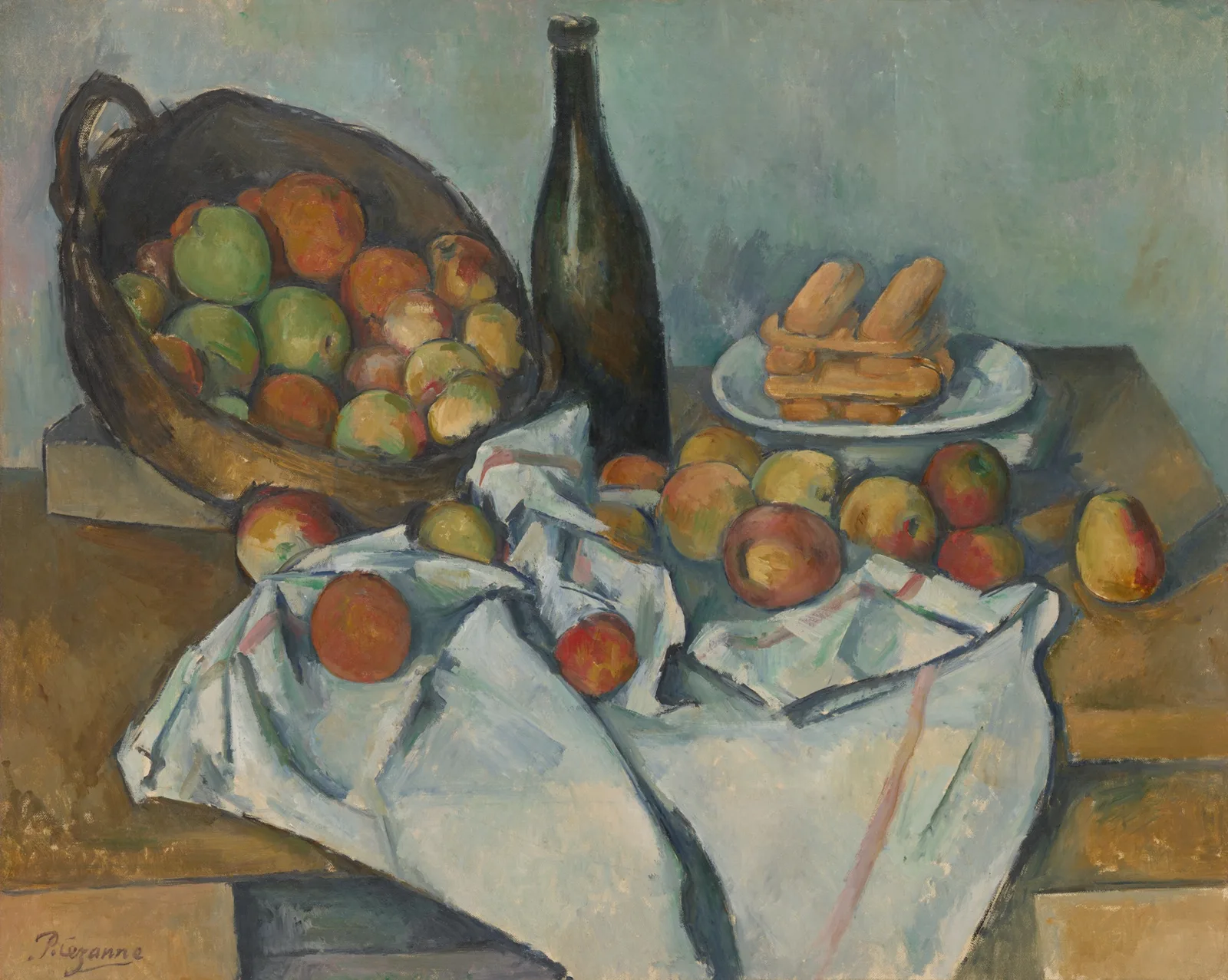
He didn’t invent that idea from nothing. Look at the painting at the top of this post, Cézanne’s “The Basket of Apples” from about 1893. The left edge of the table doesn’t meet the right edge. The basket tips toward you while the plate sits flat. Cézanne was already letting his viewpoint drift, and Picasso and Braque pushed that drift as far as it would go.
Did Picasso invent cubism?
Picasso invented cubism together with Braque, and neither of them did it alone. Tate dates the start to Picasso’s Les Demoiselles d’Avignon (1907): five nude women with faces like masks and bodies cut into sharp, flat angles. Even his friends were shocked by it. Tate splits the style that followed into two phases:
- Analytical cubism (1908 to 1912): subjects broken into small planes in muted browns, grays and blacks.
- Synthetic cubism (about 1912 to 1914): simpler shapes, brighter color and real materials glued in.
Our art history lesson puts it bluntly: Braque is often credited with inventing cubism, and Picasso’s the one who made it famous. Both are fair.
Why is collage part of Picasso’s legacy?
Because collage started in fine art with Picasso and Braque. In synthetic cubism they began gluing newspaper, wallpaper and printed labels straight onto the picture. Picasso’s “Still Life with Chair Caning” (1912) even has a piece of oilcloth printed to look like chair caning, framed with a real rope.
Tate calls putting real objects into art “the start of one of the most important ideas in modern art.” Every time you build a mixed-media piece today, you’re using that idea.
Our collage lesson calls it a different way to construct a painting, because you have to think in layers and plan ahead. That’s the shift Picasso made: the canvas stopped being a window and became a surface you build on.
Why is Guernica so important?
Guernica is important because it made people feel a war in a single picture. A horse screams with a spear through it. A mother holds her dead child and howls at the sky. A bull looms over her, and a bare light bulb glares from the top of the picture. Picasso painted it in Paris between May and June 1937, after seeing newspaper photographs of the German bombing of the Basque town of Guernica during the Spanish Civil War.
It’s huge, about 3.5 by 7.8 meters (wider than most living rooms), and painted only in black, white and grays, like the photographs he’d seen. It was made for the Spanish Pavilion at the 1937 Paris International Exposition and now hangs at the Museo Reina Sofía in Madrid.
For a painter, the lesson is about color. Picasso dropped every color on purpose. The limited palette makes the painting feel like news, and it’s one of the clearest examples of a color choice carrying meaning.
How did Picasso become so famous?
Picasso became famous through a recognizable look and an enormous amount of art. Our workshop on painting faster makes this point: when you think of Picasso, you picture a distorted face. It’s an odd brand, but it’s a successful one, and it’s why five-year-olds know his name.
The second half is volume. Guinness World Records lists him as the most prolific painter on record, with roughly:
| Kind of art | About |
|---|---|
| Paintings and designs | 13,500 |
| Prints and engravings | 100,000 |
| Book illustrations | 34,000 |
| Sculptures and ceramics | 300 |
The workshop uses those numbers to answer a fear a lot of artists carry: that painting more makes each piece less valuable. Picasso shows the opposite. The more he put out, the more people knew his name, and being known kept people wanting his art. As the workshop puts it, artists have to come out of obscurity, and the best way to do that is to paint a lot.
There’s a well-known story, never pinned to a single source, of someone asking Picasso how long a painting he’d finished in 45 minutes took him. The story goes that he answered “thirty years.” Whether or not he said it, the point holds: speed is built from years of volume.
Was Picasso famous while he was alive?
Yes, and that’s part of why he matters. Van Gogh, a generation earlier, sold almost nothing and became the model for the starving artist. Picasso was famous and wealthy for most of his 91 years.
Our Mastery Program lesson on the starving artist myth explains the difference. Van Gogh worked when art was bought through a small establishment, there was no way to reach buyers far away, and if you weren’t in the right circle you were out. Picasso had dealers, collectors and international shows. Today you have even more reach than he did, since a painting can be seen by thousands of people while the paint is still wet.
Do you have to like Picasso?
No, and you’ll grow faster as an artist if you’re honest about it. One of our Mastery Program lessons on taste walks through a museum visit where the thought was “they told me Picasso’s great, so I gotta love Picasso.” Years later, that same teacher could say out loud that van Gogh felt like poetry and Picasso didn’t.
The exercise from that lesson is worth stealing. Find a painting you’re always told to love, the one everyone says changed history, and write down why you don’t like it. That’s how you train taste that’s your own instead of borrowed.
The lesson pairs it with an idea from the music producer Rick Rubin’s book “The Creative Act”: study great art to tune your own sense of what’s great, so you make better choices in your own paintings. You study Picasso to sharpen your eye. Copying him is beside the point.
Our style lessons make the same point from the other side. They line painters up from realists, who paint exactly what’s in front of them, to interpretive painters, who paint from memory and imagination. Picasso sits at the far interpretive end. If you love detailed realism, his style may never feel like yours, and that’s fine. The painters you love, and the ones you don’t, both shape your style.
What can a painter today learn from Picasso?
You can learn four habits from him, even if you never paint a cubist face.
- Look from more than one place. Before you paint, walk around your subject. You’ll notice shapes you’d have missed from your chair.
- Let materials into the picture. Paper, fabric, a printed label. Collage belongs in serious painting as much as paint does.
- Let your color mean something. Guernica’s grays are a choice. Ask what your palette is saying before you squeeze out paint.
- Make a lot. Volume builds skill, speed and a recognizable style faster than waiting for the perfect idea.
If you want to know more about the man himself, where he trained and whether he was Spanish or Italian, read our post on Pablo Picasso’s education and the facts worth knowing. And if you’re working out where your own art sits on the style spectrum, start with how to find your art style.
Frequently asked questions
Why is Picasso so famous?
Picasso is famous because he helped invent cubism, the style that broke a subject into several viewpoints at once, and because his look became instantly recognizable. Most people picture a face with both eyes on one side when they hear his name. He also made an enormous amount of art over a 75-year career, so his paintings, prints and ceramics are in museums and homes all over the world.
Was Picasso famous while he was alive?
Yes. Van Gogh sold very little in his lifetime, but Picasso was famous and wealthy for most of his long life. He lived to 91, died in 1973, and saw major museums show his art while he was still painting.
Did Picasso invent cubism by himself?
No. Picasso developed cubism together with the French painter Georges Braque around 1907 to 1908. Tate dates the start to Picasso's Les Demoiselles d'Avignon (1907). Braque is often credited with the first truly cubist landscapes, and Picasso is the one who made the style famous.
Why did Picasso start cubism?
Picasso and Braque wanted to show a subject the way you know it, from several sides at once, instead of from one fixed spot the way Renaissance perspective did. They learned it from Cézanne, who had already let the edges of a table or a bowl shift from one viewpoint to another.
What is Picasso's most famous painting?
Guernica (1937) and Les Demoiselles d'Avignon (1907) are the two named most often. Guernica, painted for the Spanish Pavilion at the 1937 Paris International Exposition, hangs at the Museo Reina Sofía in Madrid. Les Demoiselles is at the Museum of Modern Art in New York.
Do I have to like Picasso to learn from him?
No. Plenty of serious painters don't enjoy his art. One of our Mastery Program lessons asks students to look hard at a celebrated painting they don't like and put into words why, because that's how you train your own taste instead of borrowing someone else's.
What to practice this week
- Set up three objects on a table and draw them twice: once from where you sit, then again after moving your chair a few feet. Combine both views into one drawing and notice where the edges refuse to line up.
- Make a small collage: paint a simple still life, then glue in one real scrap of paper (a ticket, a label, a page of newsprint) where it adds to the picture.
- Pick one famous painting you don't like and write three sentences on why. Then write one sentence on what it does well.
- Set a number instead of a standard for one month, such as 20 small studies, and finish every one.
Supplies used
About the author
More from Elli