How to Write a Gallery Report: What to Look For and How to Structure It
Walk in with a notebook and three questions, and you'll walk out with a report that sounds like you actually looked.


A gallery report is a short write-up of your visit to an art gallery or museum: what was on the walls, a close look at two or three artworks, and your honest response to them. The best ones read like the writer stood in front of the paintings long enough to notice something, and that comes down to knowing what to look for before you walk in.
Here’s how to prepare, what to write down in the gallery, how to describe and analyze a painting using the same checklist painters use on their own canvases, and a simple outline you can fill in when you get home.
What is a gallery report?
A gallery report is a written summary and analysis of an exhibition you visited in person (or, if your teacher allows it, online). It’s usually assigned in art, art history and art appreciation classes, and it sits between a review and an essay: more personal than a research paper, more careful than a social media caption.
Most gallery reports have three jobs:
- Record what you saw: the gallery, the exhibition, and the details of the artworks you chose.
- Analyze how a few of those artworks are made and why they work, or don’t.
- Respond with your own reaction, supported by things anyone could see in the piece.
The third job is where most reports go thin. “I really liked this painting because the colors were pretty” tells your reader almost nothing. The rest of this guide gives you the vocabulary to say what you actually noticed.
What should you do before you visit the gallery?
Spend ten minutes on the gallery’s website before you go. Read the exhibition description, note the artists and the dates of the show, and check whether photography is allowed. You’ll walk in already knowing what the show is trying to say, which makes it much easier to judge whether it says it.
Pack a notebook and a pencil (many museums don’t allow pens near the art), and your phone for photos of the wall labels if photography is permitted. Give yourself at least an hour. Rushing a gallery visit is the fastest way to end up with a report full of adjectives and short on detail.
What kind of gallery are you visiting?
Name the type of space in your report, because it changes how you read what’s on the walls. A museum collects and preserves art for the public. A commercial gallery represents living artists and sells their paintings, usually splitting each sale about 50/50 with the artist. A co-op gallery is run by its member artists, who share the costs of running the space. A rental or “vanity” gallery charges artists for wall space.
In the Mastery Program’s lesson on the gallery business model, the point made about commercial galleries is that their reputation rests on curation: the gallery is saying something with every artist it chooses to represent. So ask that question in your report. What is this gallery saying with this show? A well-hung commercial show often groups an artist’s paintings as a series, and that’s worth noticing too, because a series tells a bigger story than any one canvas can tell alone. How a gallery stages its paintings, which pieces hang together and where the strongest one sits, shapes the way you see each one, so note the arrangement as well as the art.
What should you write down in the gallery?
Write down everything on the wall label for each artwork you might use: the artist’s name, the title, the date, the medium (oil on canvas, mixed media, bronze) and the dimensions. You’ll need all of it for your report, and it’s miserable to try to remember later.
Then walk the whole exhibition once before you settle on anything. Pick two or three pieces that stopped you, ideally for different reasons. For each one, look at it from three distances. Painters call this the street test. In the Mastery Program’s critique lesson, a strong painting is described as readable from about 30 feet away, so you know at a glance it’s a landscape with a river or a portrait of a woman in a hat. At about 15 feet, it should reward you with something you missed from across the room. Up close, at three feet, there’s another reward: the brushstrokes, a faint drawing showing through, the way ink bleeds at an edge.
Note what you see at each distance. That one habit gives you three paragraphs of specific observation instead of one vague one.
How do you describe a painting using the elements of art?
Describe a painting by working through the elements of art one at a time: line, value, color, texture, form, scale and depth. In the Mastery Program’s lesson on the elements, they’re described as the vocabulary of painting. If art is a language, the elements are the words, and every artist arranges the same words differently. That’s why two painters can paint the same vase of flowers and you’d never confuse them.
Here’s what to ask about each one:
- Line: Are there visible lines or outlines, or do shapes meet edge to edge, color against color? Are the lines varied in thickness?
- Value: How light are the lights and how dark are the darks? Is there a full range, or does everything sit in the middle?
- Color: What’s the color story? Common ones are one dominant color plus an accent, a complementary palette, neutrals with one bright accent, or a rainbow held in check by plenty of gray.
- Texture: Is the texture actual (thick paint, collage, gold leaf you could touch) or visual (painted to look rough or shiny)?
- Form: Do the objects look three-dimensional, and how was that illusion built?
- Scale: How big is the piece, and how big are things inside it compared to each other?
- Depth: Can you find a foreground, a middle ground and a background? Are far edges soft and close edges sharp?
You won’t need all seven for every painting. Most artists lean hard on two or three elements and barely touch the others, and naming which ones a painter favors is one of the most useful things you can say about their style. Our guide to the 7 elements of art goes deeper on each.
How do you find the focal point of a painting?
The focal point is where your eye stops and rests, which isn’t always the first thing you notice. The Mastery Program’s critique lesson describes it this way: your eye comes in, travels around the painting, and then lands and pauses. That pause is the focal point.
To find it, stand back, look at the painting without trying to analyze it, and notice where you keep coming back to. Then work out why. Usually it’s the spot with the strongest contrast, the sharpest edges, the brightest highlight, or a face. Writing “my eye settles on the woman’s face, the only place in the painting with crisp edges and a bright white highlight” is analysis. Writing “the woman is the main subject” is description.
How do you analyze an artwork instead of only describing it?
Analysis explains how the artist made the painting work. A good test is to ask the same questions painters ask when they critique their own canvases:
- Composition: Is the subject placed off center, or dead in the middle? Is it cropped in a way that feels intentional, or awkward? Does anything touch the edge of the canvas just barely, which tends to feel cramped?
- Contrast: Are the darks dark enough and the highlights light enough to read from across the room?
- Edges: Do the edges vary, soft in the distance and crisp up front, or are they all the same?
- Integration: Does the subject belong to its background, sharing some of its colors, or does it look pasted on? Painters in our program call the second problem “this and that.”
- Interpretation: Is this a familiar subject painted in a familiar way, or a familiar subject seen in an unexpected way? The critique lesson calls the second one atypical, and it’s usually what makes a painting memorable.
For more questions in this vein, our guide on how to critique art works through twelve of them, and composition in art covers placement in detail.
What does a gallery report paragraph look like?
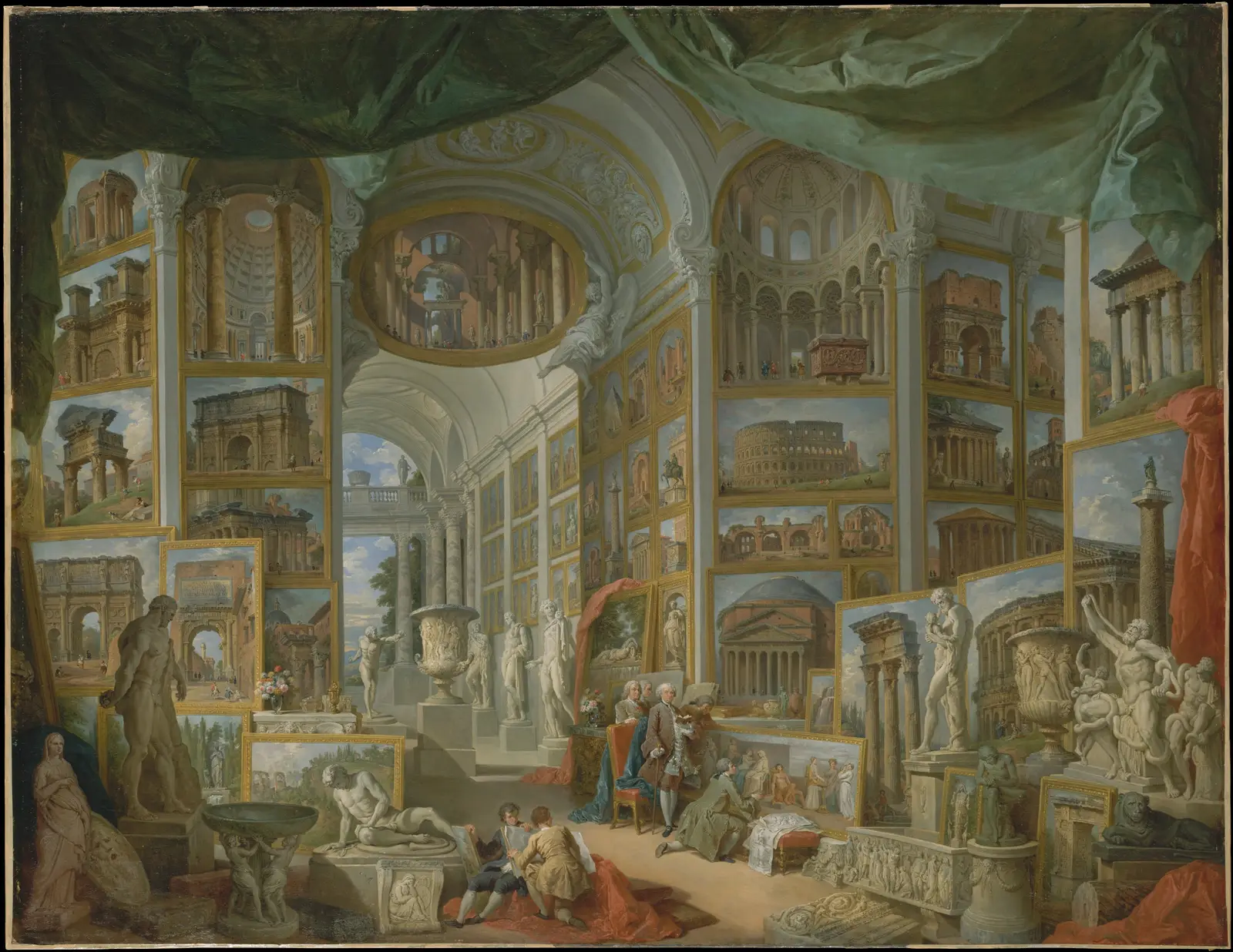
Here’s a short example built on the painting at the top of this page, so you can see description and analysis working together:
Giovanni Paolo Panini’s “Ancient Rome” (1757, oil on canvas, The Metropolitan Museum of Art) is a painting of a gallery full of paintings. The walls of an imaginary hall are hung floor to ceiling with views of Roman ruins, including the Colosseum and the Pantheon, while marble statues crowd the floor and well-dressed visitors study the pictures. Panini frames the scene with heavy green curtains across the top and stacks of canvases on both sides, which pulls the eye down the long corridor in the center. My eye finally settles on the small group of visitors around the red chair, the warmest color in a room of creams, golds and grays. Hundreds of tiny ruins compete for attention, yet the painting stays readable because the light, the architecture and that single patch of red all point to the same place.
Notice what it does: the label details come first, then a description of what’s there, then a claim about how it works, backed by something you can check with your own eyes.
How should you structure your gallery report?
Use this outline unless your teacher gives you a different one:
- Introduction: the gallery’s name and location, the date of your visit, the exhibition title, and one sentence on what the show is about.
- The exhibition: what kind of gallery it is, how the show is arranged, how many artists or pieces are included, and the overall impression.
- Artwork one: label details, description using the elements of art, the focal point, and your analysis.
- Artwork two (and three): the same, choosing pieces that let you say something new.
- Your response: which piece affected you most and why, what you’d ask the artist, and what you’ll look for next time you’re in a gallery.
- Conclusion: two or three sentences tying your response back to what the exhibition set out to do.
Write the response section last, after your analysis. By then you’ll know exactly which details earned your reaction, and you can name them.
Go look longer than feels normal
The most common thing people do in a gallery is glance, read the label, and move on. Give your two or three pieces five minutes each, from three distances, with the elements in your pocket. You’ll notice things the artist hoped someone would find, and your report will show it.
If you’d like to see these same questions from the painter’s side of the canvas, the 2-Week Challenge walks you through making a painting of your own. And if your class is studying a particular movement, our art history guides and virtual museum tours are good places to keep looking.
Frequently asked questions
How long should a gallery report be?
Follow your teacher's word count first. Without one, 500 to 1,000 words is typical: a short introduction, a paragraph or two on the exhibition, one to two paragraphs on each of two or three artworks, and a short conclusion with your response.
Can I use "I" in a gallery report?
Yes, in the response section. A gallery report asks what you saw and what you thought, so first person is expected when you share your reaction. Keep the description and analysis sections focused on the artwork itself, and back every opinion with something visible in the piece.
How many artworks should I write about?
Two or three, written about in depth, beat ten written about in a sentence each. Pick artworks that caught your eye for different reasons, so each one gives you something new to say.
What if I didn't like the exhibition?
That's allowed, and it can make a stronger report. Explain exactly what didn't work for you using the same tools: the composition, the color story, the edges, how the show was hung. A specific, fair criticism shows more looking than vague praise.
Can I write a gallery report from a virtual tour?
Check with your teacher first. Many accept a museum's online collection or a virtual tour when a visit isn't possible, as long as you say so in the report and still record each artwork's label details.
What to practice this week
- Stand in front of one painting for five full minutes before you write a word, then list everything you can see, starting with the biggest shapes.
- Find the focal point of three paintings in the same room by noticing where your eye stops and rests, and sketch a tiny thumbnail of each with that spot circled.
- Pick one painting and name its color story in a single phrase, such as one dominant color plus an accent, or a complementary palette.

About the author
More from Elli