Romantic Paintings: 5 Famous Paintings About Love and the Stories Behind Them
Some of the most famous paintings in history are about love. Here are five romantic paintings, the artists behind them, and the choices that make each one feel like romance.

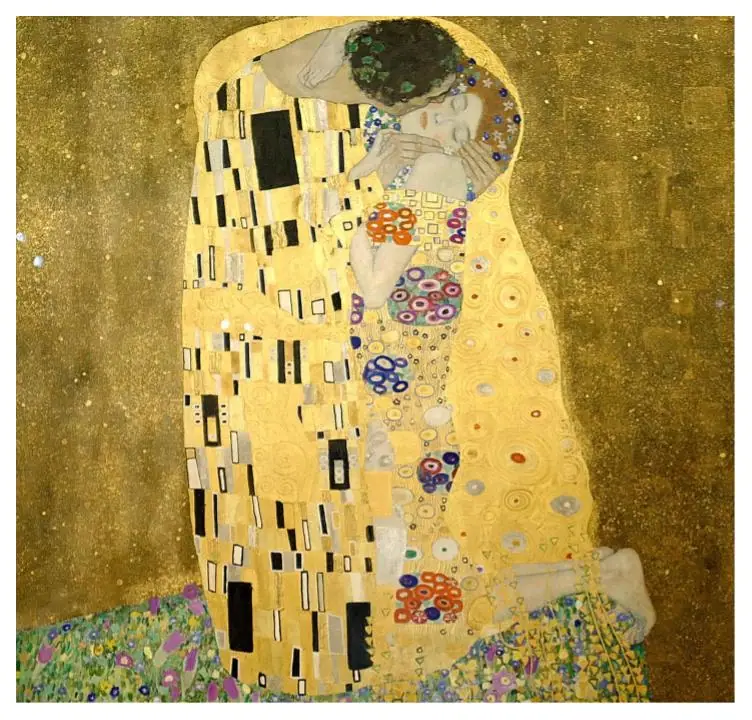

Romantic paintings express love through craft, using composition, warm color, soft light, and tender body language to make a viewer feel closeness. Five of the most famous paintings about love are The Kiss by Gustav Klimt, Dance in the Country by Pierre-Auguste Renoir, Flaming June by Sir Frederic Leighton, The Farewell of Telemachus and Eucharis by Jacques-Louis David, and The Birth of Venus by Sandro Botticelli. Art history is full of these heroic depictions of love and passion, and we have learned a great deal about love itself from the record that great artists left behind.
Many of these works were painted centuries ago and are very much products of their time, yet they carry the transcendent quality that all great paintings have. It helps to study them two ways: in the context they were made in, and thematically, by what they are about. Below, we look at five famous love paintings thematically, what each one depicts, and the specific choices that make it read as romance. If you want a wider view first, here are 20 famous paintings that shaped art history.
What are the most famous romantic paintings about love?
The most famous romantic paintings about love are The Kiss, Dance in the Country, Flaming June, The Farewell of Telemachus and Eucharis, and The Birth of Venus. Each one reaches romance by a different route: a gilded embrace, a spontaneous dance, the glow of warm light, a tender goodbye, and the goddess of love arriving by sea. Taken together they show that romance in painting is built, not just depicted.
What makes The Kiss by Gustav Klimt so famous?
The Kiss is one of the most famous paintings about love in the history of art, and its fame comes from how Klimt fused gold and pattern with raw tenderness. In this oil painting, made sometime between 1907 and 1908, Klimt used gold leaf as a decorative enhancement, so the whole surface shimmers like an object you might find in a treasury rather than a gallery.
The painting’s elements show the influence of the Art Nouveau movement, but they also reach back to earlier ages, when illuminated manuscripts and Byzantine mosaics were popular forms of art. The composition of The Kiss shows a couple in an embrace, set against a visually flat background. Geometric patterns and elegant swirls add a decorative element to the painting, and that contrast, flat gold against the two soft figures, is what makes the embrace feel so concentrated.
How does Dance in the Country by Renoir show love?
Dance in the Country shows love through movement, warmth, and an intimate choice of subject. Painted in 1883, Dance in the Country was one of three dance-themed paintings that Renoir made for his supporter Paul Durand-Ruel. The Impressionistic painting features Renoir’s wife, Aline, and depicts a couple enjoying a spontaneous dance in a country setting.
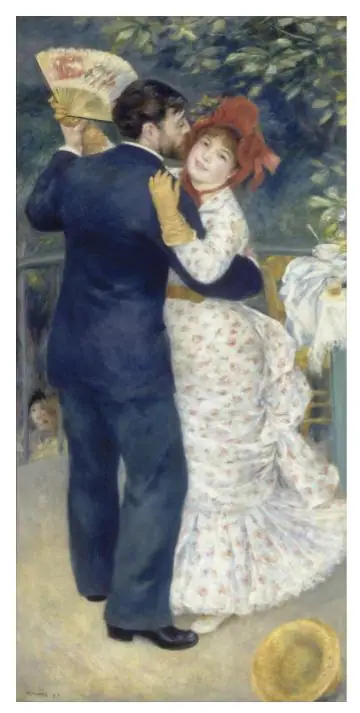
The dancers’ clothing and body language let Renoir show a real sense of movement in this painting about love. Its vibrancy and intimacy come from his choice of subject matter, along with his use of warm colors and nuanced lighting. This is a useful lesson for any painter: the feeling of a piece often lives in the body language and the color temperature long before the viewer reads the story.
Why is Flaming June considered romantic without a couple?
Flaming June by Sir Frederic Leighton shows that you do not need to paint a couple to convey romance. The romance here comes entirely from craft: soft light, warm color, and flowing clothing wrapped around a single sleeping figure. Leighton submitted the painting to the Royal Academy for an exhibition in the late 1890s.
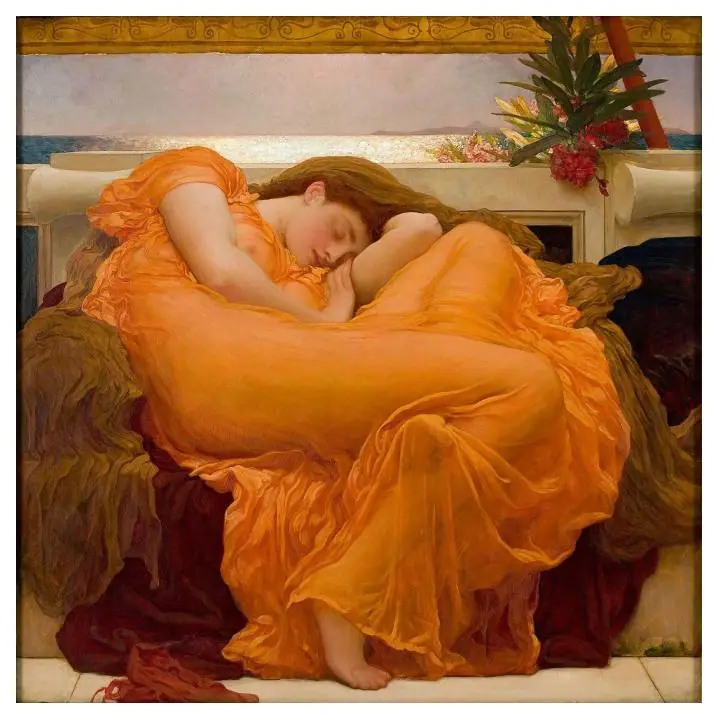
Although Leighton was a contemporary of the Pre-Raphaelites, his relationship with the other painters in that group was complicated. He agreed with their stance on poetic idealism, but he disagreed with their leanings toward realism. For our purposes, Flaming June is the clearest proof in this list that romance is a result of formal choices, since the light and color do the emotional work that a second figure usually would.
What is the story behind The Farewell of Telemachus and Eucharis?
The Farewell of Telemachus and Eucharis is a tender parting scene that Jacques-Louis David created in 1818 as a pendant to his work Love and Psyche. A pendant, that is a work created in a pair, is meant to mirror another painting thematically and is often hung beside it to create a symmetrical look. The pairing itself is part of the romance, since the two canvases were made to speak to each other.
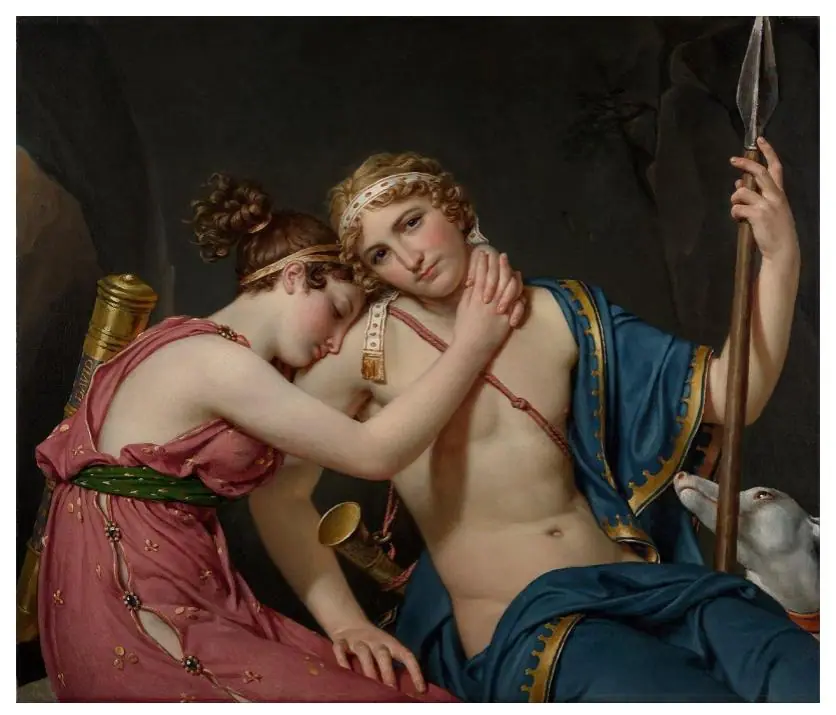
David’s mythological piece was commissioned by Count Franz Erwein von Schonborn-Wiesentheid, and it drew its inspiration from Homer’s great work The Odyssey. A goodbye between lovers, drawn from myth, is one of the oldest ways painters have shown love, because parting reveals how much the figures mean to each other. This is narrative art at its most tender: a painting that tells a whole story in a single moment of leaving.
Why is The Birth of Venus a painting about love?
The Birth of Venus is a painting about love because its subject is Venus herself, the goddess of love, which makes it a natural choice for any list of famous love paintings. It shows Venus arriving on the island of Cyprus carried by wind and seashell, with flowers and greenery around her that symbolize spring.
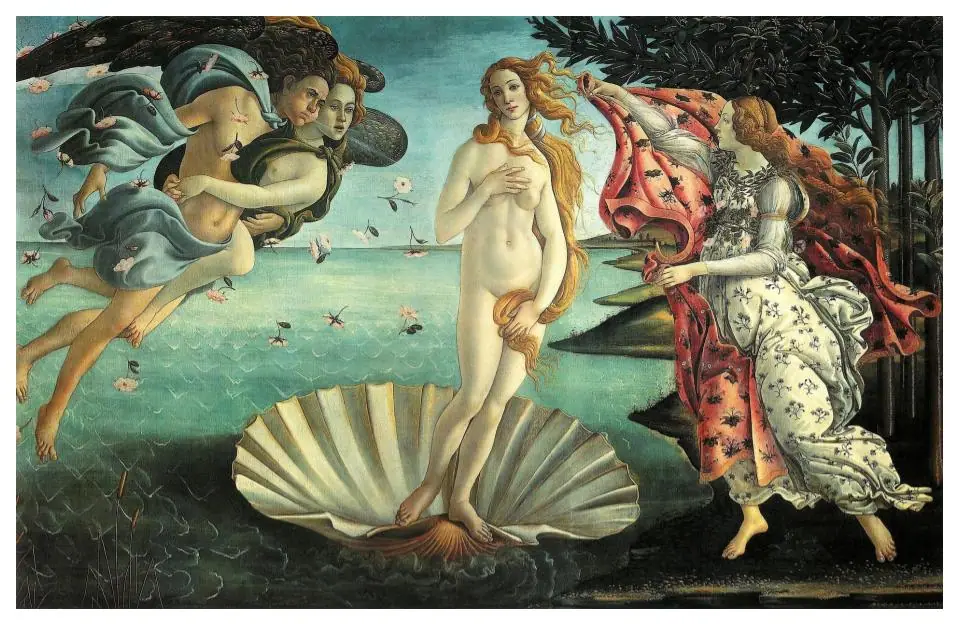
It is believed that Botticelli painted the piece around 1485, possibly for the Medici family, partly because of the orange trees in the painting. The orange tree was an emblem of the Medici, so the painting may quietly carry the name of the people who paid for it. Love here is not a private embrace but a public myth, the arrival of love into the world.
What makes a painting feel romantic?
A painting feels romantic when its formal choices, more than its subject, make you feel closeness. Across these five works the same tools keep appearing: warm color, soft and directional light, flowing fabric, tender body language, and a composition that draws two figures together or wraps a single figure in glow. Klimt does it with gold and an embrace, Renoir with movement and warm color, Leighton with light alone, David with a parting, and Botticelli with myth. The subject can be a couple, a goddess, or one sleeping woman. The romance is in the craft.
That is the real reason to study art history thematically rather than only by date. When you look at paintings by what they are about, you start to see the repeatable decisions that produce a feeling, and those decisions are things you can practice in your own work. The symbolism in art is part of this too, since objects like Botticelli’s orange trees and each warm hue carry meaning a viewer reads almost instinctively. If you want to go deeper on why this kind of study pays off, here is the case for why you should study art history.
How can you paint love and emotion into your own work?
You learn to paint love and emotion the same way these artists did: by studying the choices that create a feeling, then practicing them on your own subjects. Copy a romantic painting you admire to feel how it was built from the inside. Watch where the warm colors sit and where the light falls softest. Decide what you want a viewer to feel before you plan the composition, then build the color and light around that feeling. Emotion in a painting is a learnable skill, not a gift you are born with.
This is exactly the kind of perspective on art history and craft that we build with our students. If you want a structured, supported way to start putting feeling into your own paintings, our free Two Week Challenge is made for beginners, and the rest of our art history and famous paintings collection is here when you want to keep exploring. The great love paintings were not made by people with a secret gift. They were made by artists who learned to carry a feeling with paint, and that is something you can learn too.
Frequently asked questions
What are the most famous romantic paintings about love?
Five of the most famous are The Kiss by Gustav Klimt, Dance in the Country by Pierre-Auguste Renoir, Flaming June by Sir Frederic Leighton, The Farewell of Telemachus and Eucharis by Jacques-Louis David, and The Birth of Venus by Sandro Botticelli. Each one expresses love through a different choice: an embrace, a dance, warm light, a tender parting, or the goddess of love herself.
What makes a painting romantic?
Romance in a painting comes from craft, not just subject. Warm color, soft light, flowing fabric, and tender body language all signal intimacy, often more than the figures themselves do. Flaming June reads as romantic without showing a couple at all, because the light and color carry the feeling. A painting becomes romantic when its formal choices make you feel closeness.
What is the most famous painting of a couple in love?
The Kiss by Gustav Klimt is the most famous painting of a couple in love. Painted between 1907 and 1908, it shows two lovers wrapped together and gilded in gold leaf, set against a flat decorative background. Its Art Nouveau patterning and shimmering surface have made it one of the most recognized images of love in all of art history.
Why is The Birth of Venus considered a painting about love?
The Birth of Venus is about love because its subject is Venus, the Roman goddess of love, shown arriving on the island of Cyprus by wind and seashell. Botticelli painted it around 1485, and the flowers and greenery around her symbolize spring and new life. The orange trees may point to the Medici family, who likely commissioned it.
How can I learn to paint love and emotion into my own work?
Study how master painters carried emotion through composition, color, and light, then practice those same choices on your own subjects. Copy a romantic painting you love to feel how the artist built it, pay attention to where the light falls and where the warm colors sit, and read paintings thematically, not just chronologically. Emotion in painting is a learnable skill, not a gift.
What to practice this week
- Choose one of these five romantic paintings and copy a small study of it, watching where the warm colors and soft light fall rather than copying every detail.
- Paint a simple subject twice: once in cool neutral light, once in warm soft light, and notice how much more tender the warm version feels.
- Pick a feeling you want a viewer to have, then plan the composition, color, and light around that feeling before you draw a single line.
Supplies used

About the author
More from Elli