Archetypes in Art and Mythology: What They Are and Why We Keep Painting Them
An archetype is a universal character that lives in every human mind. Here is what archetypes mean, the female and male ones artists keep painting, and why we love them so much.

Archetypes in art and mythology are universal character patterns that show up across nearly every culture and era: the hero, the mother, the magician, the trickster, the king. The psychologist Carl Jung argued these figures live in a shared layer of the human mind he called the collective unconscious, which is why a Greek statue, a Renaissance painting, and a superhero movie can all feel like they are telling the same story. We keep painting them, and keep returning to them, because we recognize ourselves in them.
That recognition is the whole point. So potent are stories about characters like Medusa, Apollo, and Artemis that artists have felt compelled to tell them over and over for thousands of years. The question worth answering is not just what these figures are, but why the lover, the mother, and the hero fascinate us so completely. The answer sits close to the heart of who we are, both as people and as artists, and understanding it can make your own work more honest and more magnetic.
What is an archetype, and why do we need them?
An archetype is a universal character pattern that lives in the shared human mind. Most of us first met them in a classroom, studying figures like Pandora or Zeus, but archetypes are bigger than any single myth. They are the eternal characters that exist within the psyche of all humanity, the layer Jung named the collective unconscious.
In practice they are characters like the magician, the innocent, the hero, and the orphan. Modern art, film, and literature are full of them: Gandalf is the magician, Snow White is the innocent, Diana Prince is the hero, and Harry Potter, raised under the stairs, is the orphan. According to Jungian scholar Dr. Carol S. Pearson, archetypes represent patterns, and patterns give us predictability. Predictability makes us feel safe, because when we can sense what a character will do, the story feels solid under our feet.
Archetypes do not only live on the page or the canvas. To some degree all of us carry archetypes that shape how we behave. Some of our inner archetypes shift over a lifetime, and others stay constant from childhood to old age. That is exactly why these figures resonate so deeply when we meet them in art. We see ourselves reflected in them, in some small or enormous way. They show up in our dreams for us to work out, and they quietly influence what we believe about ourselves, our place in the world, and even the art we choose to make. Most of us hold more than one archetype at once, which is what makes a real person, and a memorable character, feel layered instead of flat.
There is a working artist’s reason to care about this too. Just as you carry inner archetypes, so do the people who collect your work. When a collector truly resonates with the archetype living in you, and by extension in your paintings, they feel pulled to own the work. If your art consistently carries the signal of your own archetype, you tend to gather a steady audience of people who recognize that signal over the years. This same idea drives a lot of symbolism in art, where a single recurring image carries meaning far larger than itself.
What are the female archetypes in art and mythology?
Female archetypes in art trace the stages a woman moves through, from maiden to mother to wise woman, and they reach all the way back past the Greeks and forward into today. One of the clearest is Demeter, the archetypal mother of Greek myth. She, her daughter Persephone, and Hades, god of the Underworld, are the central figures in the story the Greeks used to explain why the seasons turn.
A modern version of a powerful feminine archetype is Wonder Woman. Many people argue that superheroes like Wonder Woman and Superman are the contemporary equivalents of Greek and Roman gods and goddesses, carrying energies close to the king archetype of Zeus or the queen archetype of Hera. Wonder Woman in particular shows up constantly in visual art because she holds several archetypes at once: the divine feminine, the heroine, the wise woman, and sometimes even the good mother, depending on who is telling her story.
Taken together, feminine archetypes in mythology and art map the life stages women pass through, from girl to woman to wise woman. They are images of feminine energy and feminine power, and artists keep painting them because each stage carries its own kind of strength. The way these figures stand in for larger ideas is part of why narrative art leans on them so heavily; a single archetypal woman can carry an entire story in one frame.
What are the male archetypes in art and mythology?
Male archetypes in art mark the stages of a man, from innocent youth to warrior to king, and they are just as widespread as their female counterparts. You need only look at a statue of Hercules, or of Perseus holding the head of Medusa, to read the hero archetype instantly. These characters have been the subject of countless paintings, sculptures, books, and films across the centuries.
Modern male archetypes mirror the older ones. Superman, Batman, and even the Joker all descend from the same family of figures. The Joker is the trickster archetype taken to its extreme, and you could fairly call him Batman’s shadow made flesh. Characters like these embody masculine energy and power in both their bright and dark forms. The most mature masculine archetypes carry warrior energy or king energy, the steady, protective force of a man who has grown into his strength.
In their own right, these modern figures have become myths. Like the gods and goddesses of old, they keep getting new origin stories, and that retelling does more than keep them interesting. It lets us work out the trickier parts of their characters, and, through them, the trickier parts of our own.
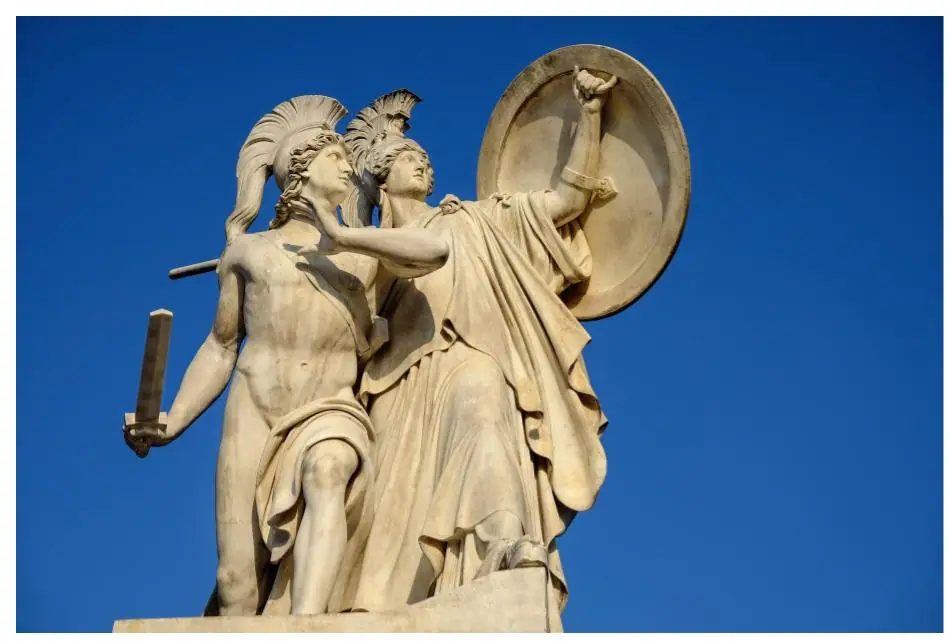
Large statues like these epitomize the reverence the ancients held for their gods and goddesses. Image by Couleur from Pixabay.
What is the shadow archetype?
The shadow is the hidden side of a character or a person, the part that holds our fear, our guilt, and our repressed desires. No honest discussion of archetypes is complete without it. According to Jungian psychology, each of us carries a shadow we keep tucked away from ourselves and from others, and art is full of it.
In painting, film, and books, the shadow usually appears as the villain. Darth Vader carries Luke Skywalker’s shadow. Voldemort carries much of Harry Potter’s. In archetypal branding, every archetype has its own distinct shadow: the magician’s shadow is doubt and uncertainty, while the hero’s shadow is the fear of downfall or cowardice. The villain is rarely random. They tend to embody the exact fear the hero most needs to face.
Part of any meaningful life involves embracing our inner archetypes and turning to confront our shadows. Art gives us a way to do both. It lets us make the most of the positive side of our personal archetype, and it helps us integrate the shadow by letting us retell the stories we carry about ourselves. The shadow is not all darkness. As the Huffington Post has noted, it offers real lessons to anyone willing to face it, and those who do tend to transcend their fears and become the hero of their own lives. That is where genuine power comes from.
Archetypes in art and mythology have a great deal to teach us about ourselves, our personalities, our world, and our place in it. The irony worth sitting with is this: it is often when we embrace the universal parts of our archetype that we become the most original, most fully ourselves version of who we are. The same is true of color and form. The recurring meanings behind color symbolism in art work much the way archetypes do, carrying shared feeling that any viewer can read.
Why do we love archetypes so much?
We love archetypes because they let us see ourselves clearly without looking directly. Watching the hero face the dragon, or the trickster upend the order of things, we recognize our own courage and our own mischief from a safe distance. That recognition is comforting and clarifying at once, and it is the reason a four thousand year old myth can still land like personal news.
For artists, this is more than philosophy. The figures you are most drawn to paint, again and again, are usually pointing at the archetype alive in you right now. Naming it, and painting it honestly rather than perfectly, is one of the surest ways to make work that feels like yours. Movements built entirely on dream logic and inner symbol, like the surrealist painters, understood this instinctively; they painted the archetype straight from the unconscious onto the canvas.
If you want to put any of this into practice, the simplest first step is to make something. Our free Two Week Challenge is a guided way to start painting and discover which figures keep recurring in your own work, and the rest of our art history and famous paintings collection is here when you want to keep exploring why these images hold us the way they do.
Frequently asked questions
What is an archetype?
An archetype is a universal character pattern that exists in the shared human mind. The psychologist Carl Jung called this shared layer the collective unconscious. Archetypes are figures like the hero, the mother, the magician, and the trickster, and they recur across myths, religions, and stories because every culture recognizes them. We carry one or more of them inside us, which is why they feel familiar the moment we meet them.
What is an archetype in mythology?
In mythology, an archetype is a recurring character type that appears across different cultures and eras. Greek myth gave us Demeter as the mother, Zeus as the king, and Hercules as the hero, and nearly every mythology has its own version of those same roles. Myths use archetypes because they make complex truths about being human easy to remember and pass down through story.
What are the feminine archetypes in art?
Feminine archetypes in art trace the stages a woman moves through, from maiden to mother to wise woman. Greek myth painted Demeter as the archetypal mother and Persephone as the maiden, while modern art gives us figures like Wonder Woman, who carries the heroine, the divine feminine, and the wise woman at once. Each one represents a different face of feminine power.
What are the male archetypes in art?
Male archetypes in art mark the stages of a man, from innocent youth to warrior to king. Statues of Hercules and Perseus carry the hero, while modern figures like Superman, Batman, and the Joker carry the hero, the protector, and the trickster. The most mature masculine archetypes hold warrior energy or king energy, both their light and their shadow sides.
What is the shadow archetype?
The shadow is the hidden side of a character or a person, the part that holds fear, guilt, and repressed desire. In Jungian psychology each of us has one, and in art it usually appears as the villain. Darth Vader carries Luke Skywalker's shadow, and Voldemort carries much of Harry Potter's. The shadow is not purely bad. Facing it is how a character, and a person, becomes the hero of their own story.
What to practice this week
- Pick one archetype, the hero, the mother, the trickster, and list five characters from art, myth, or film who carry it. Seeing the pattern repeat trains your eye to recognize it.
- Name the archetype you most identify with right now, then make a small piece of art that expresses it honestly rather than perfectly.
- Choose a painting or myth you love and find its shadow figure. Ask what fear that villain represents for the hero, then notice the same fear in yourself.
About the author
More from Elli