Realism Art History: The Movement That Painted Life as It Is
Realism began as a revolt against idealized art, and its central lesson, that ordinary life deserves the canvas, still shapes how artists see today.


Realism is the 19th century art movement that decided ordinary life was worth painting. Beginning in France in the late 1840s, Realist painters set aside the drama of Romanticism and the polish of academic art and turned instead to farmers, laborers, and quiet unposed moments, painted honestly, flaws and all. Nearly two centuries later, the movement still teaches artists its central skill: how to truly see.
What is Realism in art?
Realism is art built on a simple conviction: paint life as it actually is, not as we wish it looked. It pulls back the curtain on everyday life, stripping away idealism and fantasy to embrace things as they are. Instead of chasing perfection or embellishment, Realism grounds us in reality and insists that every wrinkle, shadow, and imperfection matters.
That conviction sounds gentle now. In the 1800s it was radical. Salons and academies expected gods, heroes, and grand moments from history. Realist painters answered with stonebreakers, gleaners, and small-town funerals. Gustave Courbet, the movement’s loudest champion, compressed the whole philosophy into one famous line:
I have never seen an angel. Show me an angel, and I will paint one.
For the Realists, painting was an art of the visible and the true.
When did the Realism era begin, and what caused it?
Realism emerged in France in the late 1840s as a direct response to Romanticism. Where Romanticism indulged in emotion and grandeur, Realism insisted on honesty, reflecting the unpolished truths of life. Realist painters wanted their work to resonate with viewers through relatable moments, so they focused on farmers, workers, and other figures from ordinary life.
The timing was no accident. The revolutions of 1848 had pushed the lives of working people to the center of public attention in France, and painters followed. The impulse itself was older: Caravaggio had painted saints with the faces and dirty feet of ordinary Romans centuries earlier, a story we explore in Caravaggio: lighting a dark world. What made Realism new was its insistence that the modern, common world deserved the scale and seriousness that academies reserved for history painting. When Courbet painted an ordinary village funeral, A Burial at Ornans, on a canvas more than twenty feet wide, critics were scandalized. He had given everyday people the size of kings.
What are the characteristics of Realism art?
Realist paintings share a commitment to ordinary subjects, truthful detail, and unsentimental observation. If you are trying to identify the style or practice it yourself, look for these traits:
- Ordinary subject matter. Laborers, farmers, domestic scenes, and street life replace gods, heroes, and idealized beauties.
- Honest treatment. Dirt, fatigue, wrinkles, and worn clothing stay in the picture. Nothing is prettied up to flatter the viewer.
- Accurate observation. Careful proportions, believable anatomy, and truthful light and shadow anchor the image in the real world.
- Muted, observed color. Realists favored the earthy palette of actual life over theatrical color effects.
- Dignity without sentimentality. Subjects are neither mocked nor glorified. They are simply seen, and that seeing is the point.
One distinction matters here: Realism is not the same as photographic rendering. Mastering the style requires precision with proportions, shading, and light, but the goal was never to mimic a camera. Realist painters wanted to capture the essence of a subject and give viewers a sense of connection to the person or moment on the canvas, not just a visual record.
Who were the most famous Realist artists?
Gustave Courbet and Jean-François Millet led the movement, and their two best known canvases still define it. Neither man painted picturesque scenery or idealized figures. They focused on people and work that society often ignored.
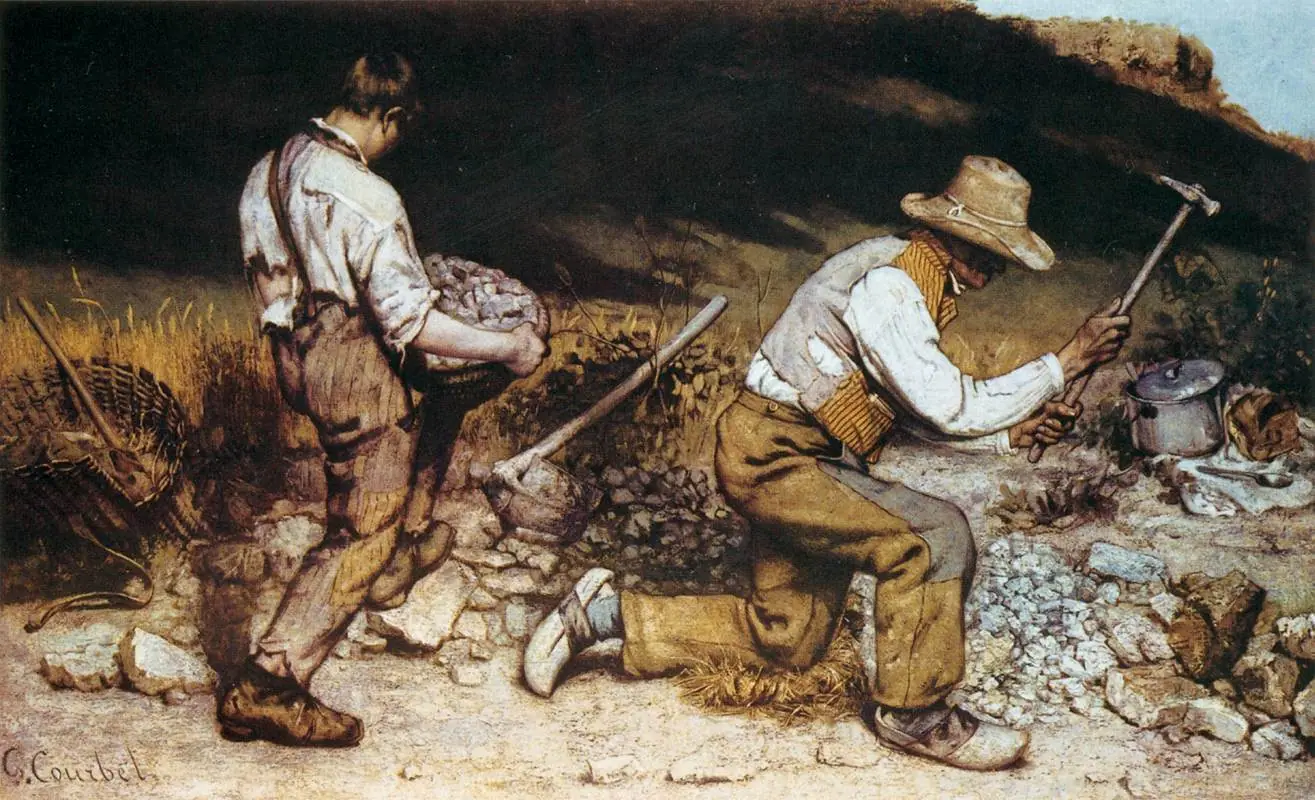
Courbet’s The Stonebreakers (1849) captures two men breaking rocks along a road, their clothes dusty and tattered. Rather than romanticizing the labor, Courbet forces us to confront the reality of the work: the exhaustion, the routine, and the dignity in simply getting the job done. He believed art should reflect real life rather than fantasy, which made the painting a protest against elitist, idealized depictions of society. Courbet never stopped provoking. When the 1855 Exposition Universelle rejected his major works, he built his own exhibition nearby and called it the Pavilion of Realism. The Stonebreakers itself was destroyed in the bombing of Dresden in 1945 and survives only in reproductions, which makes its honesty feel even more precious.
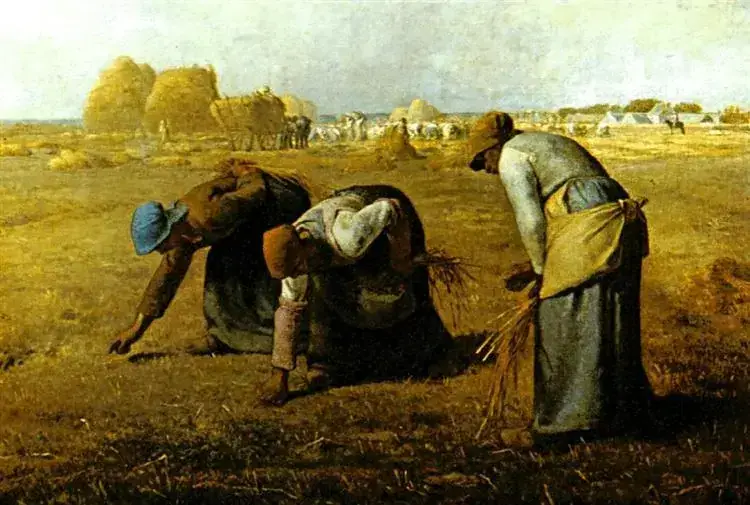
Millet looked to the countryside instead. The Gleaners (1857) portrays three women gathering leftover grain after a harvest, an act of survival and perseverance. His sympathetic portrayal carries a profound message: even the most humble actions hold worth. Through paintings like this one, Millet elevated common laborers and made it clear that simple, unnoticed moments deserve artistic attention.
They were not alone. Honoré Daumier turned the same honest eye on Parisian city life, and Rosa Bonheur brought it to rural labor and animals. Both The Stonebreakers and The Gleaners earned places among the most famous historical oil paintings ever made, and you can study The Gleaners up close at the Musée d’Orsay in Paris, or from your own studio through virtual museum tours.
How do you learn to see like a Realist painter?
You learn by training your eye to observe with intention before you ever pick up a brush. Working in this style takes more than technical skill. Realist artists notice the subtleties others miss: how fabric folds, how light moves across a surface, how a fleeting expression hints at a deeper story.
This approach refuses to rush. Instead of racing to finish a painting, you slow down and absorb the scene in front of you, searching for what is unique in the ordinary. The discipline pays off twice. Your drawing, shading, and composition sharpen, because honest observation demands accuracy. And your artistic voice deepens, because you learn to capture reality not only as it looks but as it feels.
Why does Realism still matter for artists today?
Realism still matters because its core lesson, careful attention to real life, is the foundation nearly every other style builds on. In a world filled with distractions and superficial filters, learning to observe life with care reconnects us with what is real. Realism teaches patience and appreciation for the small things.
Its influence runs forward through art history too. By dragging modern life onto the canvas, the Realists opened the door for the Impressionists, who carried everyday subject matter out into the open air. You can borrow their approach with these tips for painting like an Impressionist. And today’s artists keep evolving the tradition. Some combine realist observation with abstract painting techniques or personal storytelling. Some use the style to honor overlooked communities or to depict everyday moments in ways that feel intimate and honest. If you want to watch that blend in action, our free workshop on painting a portrait in Abstract Realism shows realist observation and expressive abstraction working together.
However it evolves, Realism keeps reminding us that ordinary moments are worth celebrating, because they reflect who we are at our core.
In the end, Realism is more than a style. It is a way of seeing the world with clarity and respect, where every person, every task, and every moment matters. Start where the Realists started: choose one quiet, ordinary scene this week and give it your full attention. If you want company on the way, the 2-Week Challenge is a gentle place to begin, and you can keep exploring the movements that shaped painting in our art history and famous paintings hub.
Frequently asked questions
When did the Realism art movement start?
Realism emerged in France in the late 1840s as a direct response to Romanticism. Gustave Courbet's The Stonebreakers, painted in 1849, is one of the earliest landmark works of the movement.
What are the main characteristics of Realism in art?
Realist painting depicts ordinary people, work, and daily life with honest, unidealized detail. It avoids fantasy and embellishment, relying on accurate proportions, truthful light and shadow, muted observed color, and an unsentimental respect for its subjects.
Who are the most famous Realist artists?
Gustave Courbet and Jean-François Millet led the movement in France. Courbet painted laborers and everyday scenes with unflinching honesty, while Millet portrayed rural workers, most famously in The Gleaners. Honoré Daumier and Rosa Bonheur also worked in the Realist spirit.
Is Realism the same as painting photorealistically?
No. Realism is about truthful subject matter and honest observation, not photographic precision. A Realist painting aims to capture the essence and dignity of an ordinary moment, giving viewers a sense of connection rather than a mechanical visual record.
What to practice this week
- Spend ten minutes with one ordinary scene (your kitchen table, a window, your own hands) and sketch only what is actually there, with no embellishment.
- Make a grayscale value study of a working figure, focusing on accurate proportions and honest light before you touch color.
- Choose one overlooked everyday moment this week and paint it as it is, flaws included.
Supplies used

About the author
More from Elli