Pablo Picasso: His Education, Whether He Was Italian, and the Facts Worth Knowing
He was Spanish, trained from age seven, quit art school early, and made tens of thousands of works. Here is the honest story of how Pablo Picasso actually learned to paint.
Pablo Picasso was a Spanish painter, born in Málaga in 1881 and dead in 1973, and he is widely considered the most influential artist of the 20th century. He was not Italian, a mix-up that comes up often because he spent most of his adult life in France and was reshaped by a single visit to Italy. His education began at home, with his father, before he was ten. He trained briefly at Spain’s most prestigious art schools, then walked away to teach himself. If you only remember one thing, remember that his genius was built, not handed to him.
That last point is the reason an art-education company writes about him at all. Picasso is held up as proof that some people are simply born different, and the actual record says almost the opposite. He started young, he trained hard, he copied the masters obsessively, and he worked for seventy years without stopping. This is the honest story of how he learned, where he studied, and the few facts people most often look up about him.
Was Pablo Picasso Italian?
No, Pablo Picasso was Spanish, not Italian. He was born Pablo Ruiz Picasso in Málaga, on the southern coast of Spain, in 1881. The reason so many people search whether he was Italian is that he left Spain as a young man and spent the bulk of his life in France, and because his first trip to Italy in 1917 changed his work so visibly that his “Italian” period became famous.
So where the confusion is understandable, the answer is not in doubt. His nationality was Spanish. His first language was Spanish. His earliest training happened in Spain under a Spanish painter. He simply became an international figure, the way many artists of his era gravitated toward Paris, and he died in France in 1973 at the age of 91. Italy shaped one chapter of his style. It never changed where he was from.
What education did Pablo Picasso have?
Picasso’s most important teacher was his own father. José Ruiz Blasco was a painter and a professor of art, and he began training his son at around age seven. His method was traditional and demanding: he had the boy copy the masters and learn their techniques before attempting anything original. That early grounding in disciplined, classical copying is the foundation everything else was built on, and it is worth sitting with if you believe great artists skip the fundamentals. They almost never do. If you want the case for why this kind of study matters, here is why study art history for any working artist.
As a teenager, Picasso’s formal schooling continued. He studied at the School of Fine Arts in Barcelona, where his father taught, and his ability was advanced enough that he moved quickly through work that took other students years. The training was rigorous and academic, the opposite of the freewheeling modern artist many people picture when they hear his name.
Where did Picasso go to art school, and did he finish?
Picasso went to art school but did not stay. After Barcelona, at sixteen he was admitted to the Royal Academy of San Fernando in Madrid, the most prestigious art school in Spain. It was the kind of acceptance most students would build a career on. He lasted only a short time.
The formal education felt confining to him almost immediately. Rather than sit through a curriculum he found suffocating, Picasso stopped attending and spent his days inside the Prado, Madrid’s great art museum, studying the paintings directly. He learned from El Greco, Velázquez, Goya, and the other masters on those walls, on his own terms and at his own pace. So the honest answer to whether he finished art school is no. He took what the institutions could give him, which was real, and then he left to keep learning by looking, which is its own kind of education.
When did Picasso start painting?
Picasso started painting in early childhood, with formal instruction from his father beginning around age seven. He showed striking ability young, and by his teens he was already producing polished academic paintings that would be impressive at any age. He never really stopped. He kept making art into his nineties, which is one reason his body of work is so staggeringly large.
This is the part worth holding onto if you are starting later than seven. The lesson of Picasso is not that you must begin in childhood to matter. It is that consistent, lifelong work compounds into something extraordinary. He simply had a very long runway and refused to coast on any of it.
What happened when Picasso visited Italy?
Picasso’s first visit to Italy in 1917 pushed his work toward classicism, and it is the trip that fuels the “was Picasso Italian” confusion. Until then he was deep in the modern, fractured language of Cubism, the style he had helped invent. In Italy he absorbed the Renaissance masters, Raphael among them, and the painter Ingres who had looked back to them.
What followed was a “return to order,” a calmer, more classical style with fuller figures and traditional dress. One of its best-known pieces, Two Women Running on a Beach, shows two full-figured women running with arms extended and hair flowing against a vivid blue sky. The mood is open and full, often read as a longing for a life of abundance rather than war. What matters for any artist studying him is the method: he did not abandon what he knew. He folded the classical into the modern and kept both.
What were Picasso’s biggest contributions to art?
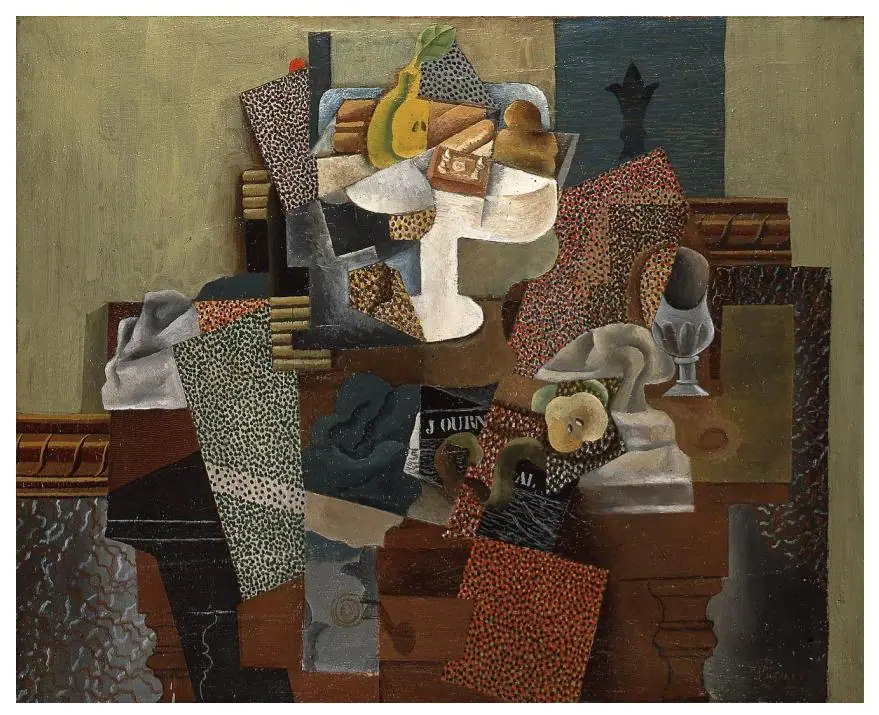
Picasso’s biggest contribution was helping invent Cubism, the most influential new way of seeing in modern art. With Georges Braque, he broke objects into facets and showed several viewpoints at once on a single flat surface, which dismantled the rules of perspective that had held since the Renaissance. The still life above is an early example of that language. Cubism reshaped what painting was allowed to be, and nearly every modern movement that followed reckoned with it.
He pushed materials just as hard. Picasso is a pioneer of collage in fine art: in 1912 he and Braque began gluing paper, fabric, and printed scraps directly onto their work, a technique called papier collé that opened modern art to ordinary, found materials. Decades later, in 1949, he worked with the artist Henri Goetz to convince the manufacturer Sennelier to develop a richer oil pastel, the wax-and-oil sticks many artists still use today. His curiosity about what art could be made of was as restless as his curiosity about what it could show.
Why does Picasso matter to artists learning today?
Picasso matters because his career is the clearest argument that skill is trained, not gifted, and that lesson outlasts any single painting. He is often cited as having made tens of thousands of works across his lifetime, an output that only a fierce, daily work ethic could produce. His art was not a hobby he returned to when inspired. It was the center of his life for seventy years.
Three threads run through his story, and all three are things you can copy. He learned by studying and reproducing the masters before he broke from them, the same path artists have walked for centuries, and the reason copying other artists helps you find your style rather than erasing it. He stayed relentlessly curious, pushing into new tools and new ways of seeing instead of settling into one safe style. And he simply worked, with a consistency most people never give their own creativity. None of that required being born Picasso. It required treating art as a craft you build, the way the 7 elements of art are learned one at a time, brick by brick.
That is the encouraging part of his story, and the true one. The talent we romanticize was, on closer inspection, decades of disciplined practice wearing the costume of genius. You can find more figures who prove the same point in our art history and famous paintings collection. If you want a structured, supported way to start building real skill yourself, our free Two Week Challenge is made for exactly the beginner who suspects the door is closed. It is not. It never was.
Frequently asked questions
Was Pablo Picasso Italian?
No. Pablo Picasso was Spanish, born in Málaga, Spain, in 1881. The confusion is common because he spent most of his adult life in France and visited Italy in 1917, a trip that reshaped his style toward classical forms. But his nationality was Spanish, and his earliest training and language were Spanish. He died in France in 1973.
What education did Pablo Picasso have?
Picasso's first and most important teacher was his father, a painter and art professor who began training him at about age seven. As a teenager he studied at the School of Fine Arts in Barcelona and was admitted to the Royal Academy of San Fernando in Madrid, Spain's most prestigious art school. He found formal study confining and left early to learn on his own.
Did Picasso go to art school?
Yes, but he did not stay long. Picasso trained at the School of Fine Arts in Barcelona and was accepted into the Royal Academy of San Fernando in Madrid as a teenager. He quickly felt boxed in by the formal curriculum and stopped attending, spending his days instead studying paintings in the Prado museum. Much of his real education was self-directed.
When did Picasso start painting?
Picasso started painting in early childhood, receiving formal instruction from his father at around age seven. He showed unusual ability young, and by his teens he was producing accomplished academic work. He kept making art for the rest of his life, into his nineties, which is part of why his output is so enormous.
How tall was Pablo Picasso?
Pablo Picasso was relatively short, commonly reported at about five feet four inches, or roughly 1.63 meters. His height is one of the more frequently searched facts about him, though it had nothing to do with his work. What set him apart was a restless, lifelong drive to keep inventing new ways to make art.
What to practice this week
- Pick one master whose work moves you, the way Picasso studied Raphael and Ingres, and copy a single piece of theirs from start to finish to learn how they built it.
- Spend a week copying before you invent. Reproduce a painting you admire to absorb its decisions, then change one element to begin making it your own.
- Set a volume goal, not a perfection goal. Picasso worked relentlessly for decades, so commit to finishing a set number of small studies this month rather than one flawless piece.
Supplies used
About the author
More from Elli